







Countries:

Payroll Oursourcing

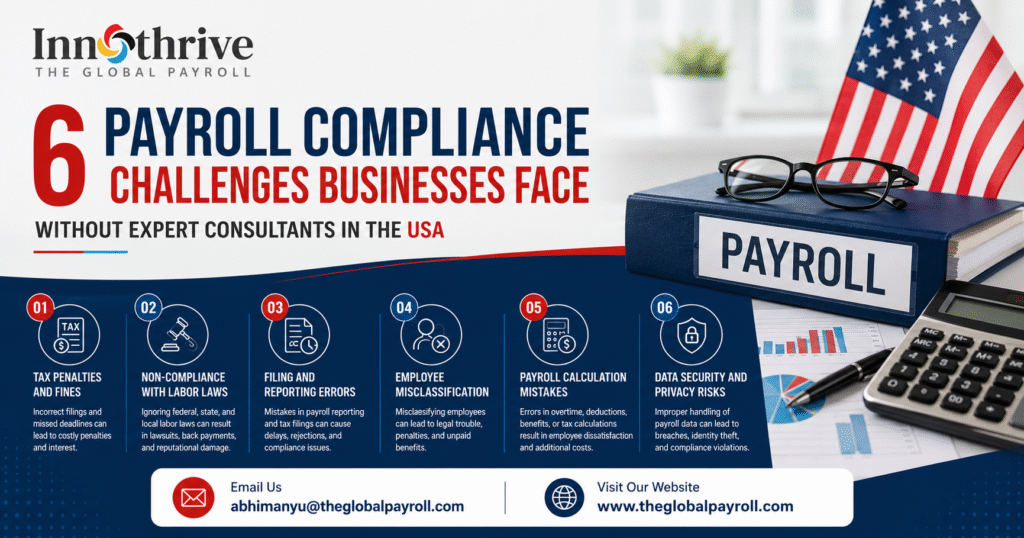
6 Payroll Compliance Challenges Businesses Face without Expert Consultants in the USA

6 Payroll Compliance Challenges Businesses Face without Expert Consultants in the USA

Managing payroll in the United States has never been a “set it and forget it” task. As we navigate through 2026, the complexity of federal, state, and local regulations has reached a fever pitch. For businesses attempting to manage these functions in-house without the guidance of expert consultants like Innothrive Solutions, the risks are no longer just administrative—they are existential. From the sweeping permanent tax changes of the One Big Beautiful Bill Act (OBBBA) to the intricate nuances of multi-state remote work, the margin for error has vanished. Without a dedicated partner to navigate these waters, companies often find themselves drowning in a sea of “stealth” regulations and astronomical penalties. Here are the six most critical payroll compliance challenges businesses face when they go it alone in the current US landscape. Navigating the Post-OBBBA Tax Landscape The implementation of the One Big Beautiful Bill Act (OBBBA) has fundamentally altered federal reporting. While it brought permanent extensions to individual tax rates, it introduced complex new deductions for qualified tips and overtime compensation. The Challenge: Employers must now track and report these items using specific new codes (like Code TP for tips and Code TT for overtime) in Box 12 of the W-2. The Risk: Miscalculating these deductions doesn’t just result in an incorrect paycheck; it triggers IRS audits. Without a consultant to interpret the 2026 Publication 15-T guidelines, businesses often fail to update their withholding tables, leading to systemic under-withholding across the entire workforce. The Multi-State Tax “Nexus” Nightmare In 2026, the “hybrid office” is the standard, not the exception. However, having an employee work from a spare bedroom in a different state creates a tax nexus. Each state has its own: Minimum wage thresholds (many of which increased significantly on January 1, 2026). State Unemployment Insurance (SUI) rates. Paid Family and Medical Leave (PFML) contribution requirements. Innothrive Solutions specializes in global and domestic multi-jurisdictional payroll, ensuring that you aren’t accidentally violating local labor laws in a state where you don’t even have a physical office. Employee Misclassification and the 1099 Shift The line between an independent contractor and a full-time employee has become a primary target for Department of Labor (DOL) enforcement. With the 2026 reporting threshold for 1099-NEC forms increasing to $2,000, many businesses mistakenly believe the “pressure is off.” In reality, the opposite is true. The IRS and DOL have ramped up scrutiny on “gig” workers. If a consultant is not auditing your worker classifications, you risk “lock-in” letters from the IRS, which dictate specific withholding rates for misclassified staff and demand years of back-taxes and interest. SECURE 2.0 and Roth Catch-Up Mandates 2026 marks a major milestone for the SECURE 2.0 Act. Specifically, employees aged 50 or older who earned $150,000 or more in the previous year must now make their catch-up contributions to 401(k) plans on a Roth (after-tax) basis. The Expert Advantage: An expert consultant ensures your payroll system is programmed to recognize these salary thresholds automatically. The DIY Failure: Manually tracking who is 50+, who hit the $150k mark, and ensuring their contribution is diverted to a Roth account is an administrative minefield that frequently leads to plan disqualification. Managing Real-Time Regulatory Volatility Payroll laws are no longer updated annually; they are updated “as-needed” through sub-regulatory guidance. For example, the Social Security wage base has climbed to $184,500 for 2026. A business without a consultant relies on software updates that may or may not be timely. Innothrive Solutions acts as a proactive shield, monitoring shifts in the Fair Labor Standards Act (FLSA) and FMLA administration in real-time. When a municipal-level wage rate changes mid-quarter, an expert ensures your system adapts before the first check is cut. The “Hidden” Cost of Manual Data Entry Even with basic software, many businesses still rely on manual data transfers between time-tracking, HR, and payroll systems. In 2026, the average cost of a single payroll error—like failing to enter a new hire correctly—exceeds $600 per employee when accounting for labor, corrections, and potential fines. “Most compliance problems don’t start with significant policy failures. They begin with small administrative gaps that compound over time.” — Industry Insight Comparison: In-House vs. Expert-Led Compliance Feature In-House Management Innothrive Solutions (Consultant-Led) Tax Updates Manual or Software-Dependent Automated & Audited in Real-Time Multi-State Coverage High Risk of Missed Local Filings Comprehensive Nexus Management Penalty Liability Business Bears All Costs Errors Covered by Service Agreements Audit Support Stressful & Reactive Audit-Ready Docs Provided Instantly Employee Trust Erodes with Recurring Errors Strengthened by 100% Accuracy Conclusion The US payroll environment in 2026 is too volatile for “best guess” management. Between the OBBBA reporting requirements and the expanding web of state-level leave laws, the cost of an expert consultant is a fraction of the cost of a single government audit. Innothrive Solutions provides the specialized knowledge, technology, and strategic oversight required to transform your payroll from a liability into a seamless business function. We don’t just process checks; we provide the peace of mind that comes with total statutory compliance.

6 Payroll Compliance Challenges Businesses Face without Expert Consultants in the USA Read More »

Payroll in India for Foreign Employees

Payroll in India for Foreign Employees: What Global Employers Need to Get Right

As international companies deepen their presence in India, the composition of their workforce is becoming increasingly global. Foreign executives are being relocated to oversee regional operations, technical specialists are being deployed for project-based assignments, and multinational businesses are bringing in international talent to support expansion efforts across the country. While hiring foreign employees in India may appear to be an extension of an organization’s global workforce strategy, payroll quickly becomes one of the most complex operational challenges. What seems like a routine salary payment often sits at the intersection of tax regulations, immigration requirements, social security obligations, and local employment laws. For foreign companies, understanding these obligations is no longer just a matter of compliance. It is becoming an essential component of successful market entry and workforce management. Why Foreign Employee Payroll Demands Special Attention Many global employers assume that paying a foreign employee is simply a matter of transferring compensation from headquarters or continuing payroll through the employee’s home country. In reality, Indian regulations take a far more nuanced view. The moment a foreign national begins working in India, employers must evaluate how the individual’s income should be taxed, whether local payroll reporting requirements apply, and whether statutory contributions become mandatory. These considerations are influenced by factors such as the employee’s residency status, duration of stay, visa category, compensation structure, and even the existence of international agreements between India and the employee’s home country. What makes payroll particularly challenging is that these factors rarely operate independently. A decision made for tax efficiency can have implications for labor compliance, while a payroll arrangement designed for administrative convenience may create unexpected regulatory exposure. The Tax Question Every Employer Must Address One of the most misunderstood aspects of foreign employee payroll in India is taxation. Many organizations continue to believe that salaries paid outside India remain outside the Indian tax framework. However, Indian tax authorities generally focus on where services are performed rather than where salary payments originate. If an employee is rendering services in India, all or part of that compensation may become subject to Indian taxation. For multinational employers, this creates additional layers of responsibility. Tax withholding obligations must be managed correctly, payroll records must align with compensation arrangements, and reporting requirements must be fulfilled within prescribed timelines. The challenge becomes even greater when expatriates receive compensation from multiple entities across different jurisdictions. Split-payroll structures, international allowances, stock-based compensation, and tax equalization arrangements can significantly complicate payroll calculations and reporting requirements. Social Security and the International Workforce Beyond taxation, social security compliance presents another area where foreign employers often encounter uncertainty. India’s Provident Fund framework may apply to certain foreign nationals classified as international workers. Whether contributions are required depends on several factors, including nationality, employment arrangements, and the applicability of social security agreements between India and the employee’s home country. For employers unfamiliar with the Indian regulatory landscape, determining these obligations can be difficult. Incorrect treatment may not only result in compliance issues but can also affect employee compensation planning and assignment costs. As organizations continue to move talent across borders, social security compliance has become an increasingly important part of global mobility strategy rather than simply a payroll function. Payroll and Immigration Compliance Are More Connected Than Many Realize Payroll compliance does not exist in isolation. It is closely tied to immigration and work authorization requirements. When foreign nationals work in India, employers must ensure that employment arrangements are consistent with visa conditions and local regulations. Authorities increasingly expect payroll records, employment contracts, compensation structures, and immigration documentation to align with one another. Any inconsistency between these elements can create avoidable compliance risks. As a result, leading multinational organizations are adopting a more integrated approach, where payroll, legal, HR, and mobility teams collaborate throughout the employee lifecycle. The Hidden Risk of Expansion For companies entering India for the first time, payroll decisions can sometimes have broader implications than anticipated. Employing personnel in a new jurisdiction may contribute to what tax authorities consider a permanent establishment, potentially triggering additional corporate tax obligations. While payroll itself is only one component of that assessment, workforce structure and employment arrangements often play a significant role. This is one reason why many international businesses seek local expertise before making hiring decisions. The objective is not simply to process salaries correctly, but to ensure that employment models support broader business objectives without creating unintended liabilities. Why Many Global Employers Turn to Employer of Record Solutions As international hiring becomes more common, many organizations are questioning whether establishing a local entity is the most efficient way to employ a small number of foreign or locally based employees in India. This has contributed to the growing adoption of Employer of Record (EOR) services. Under an EOR model, the legal employment relationship is managed through a locally compliant employer, while the foreign company retains day-to-day operational control over the employee. Payroll administration, statutory compliance, tax withholding, employment contracts, and labor law requirements are handled through a framework designed specifically for the Indian market. For global employers, the value extends beyond administrative convenience. An effective EOR partner provides access to local expertise, reduces compliance exposure, accelerates hiring timelines, and allows organizations to scale their workforce without the immediate need to establish a legal entity. Looking Ahead India remains one of the world’s most attractive destinations for international business expansion and talent deployment. As companies continue to build globally distributed teams, foreign employee payroll will play an increasingly important role in ensuring operational success. What was once viewed as a back-office administrative function has evolved into a strategic area that touches tax planning, workforce mobility, regulatory compliance, and market-entry strategy. Organizations that approach payroll proactively supported by local expertise and compliant employment structures are better positioned to navigate complexity, support their employees effectively, and expand confidently in one of the world’s most dynamic business environments.

Payroll in India for Foreign Employees: What Global Employers Need to Get Right Read More »