








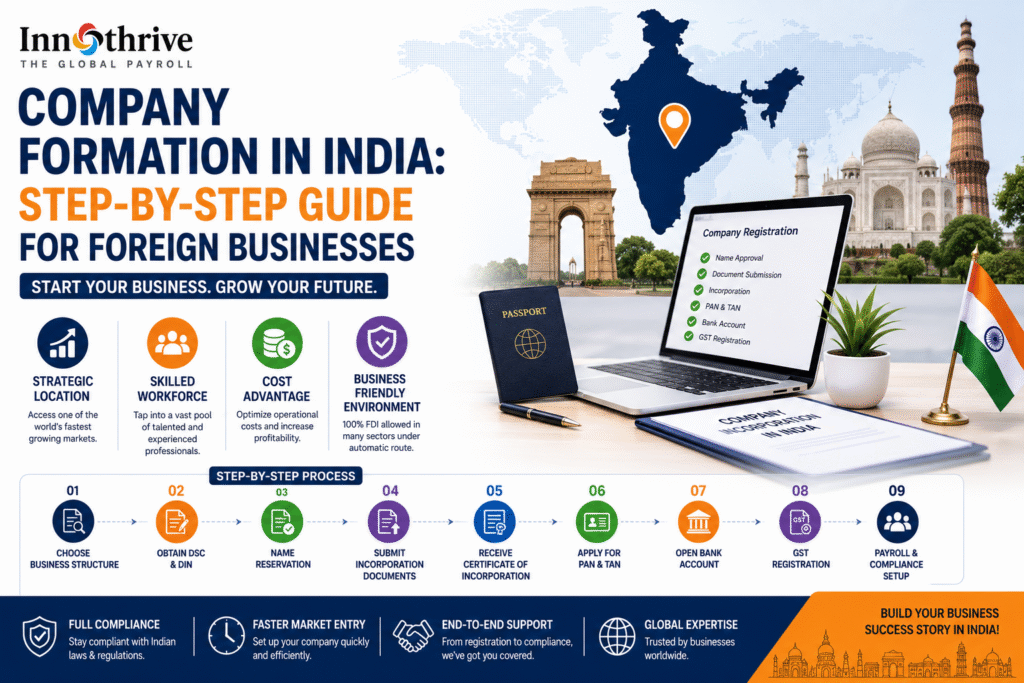
Company Formation in India: Step-by-Step Guide for Foreign Businesses
India has become one of the world’s most attractive destinations for foreign investment. With one of the fastest-growing economies, a highly skilled workforce, a rapidly expanding digital ecosystem, and government initiatives encouraging foreign direct investment (FDI), thousands of international companies are entering the Indian market every year. Whether you’re a startup from the United States, a technology company from Europe, or an established enterprise looking to expand into Asia, company formation in India offers access to over 1.4 billion consumers and one of the world’s largest talent pools. However, establishing a business in India involves legal procedures, regulatory approvals, tax registrations, and ongoing compliance obligations. This guide explains everything foreign businesses need to know about setting up a company in India. Why Foreign Businesses Choose India India offers significant advantages for international companies. Large Consumer Market India is one of the world’s fastest-growing consumer markets, creating opportunities across manufacturing, IT, fintech, healthcare, retail, logistics, and professional services. Highly Skilled Workforce India produces millions of graduates every year, including engineers, software developers, accountants, finance professionals, and management graduates. Cost Advantage Compared to many developed countries, India offers significantly lower operational and employment costs while maintaining high-quality talent. Strong Digital Infrastructure India has rapidly adopted digital technologies including: Digital banking Online company registration GST portal Digital signatures UPI payments E-governance services These systems make doing business more efficient. Can Foreigners Register a Company in India? Yes. Foreign individuals and companies can establish businesses in India subject to the Foreign Direct Investment (FDI) policy and sector-specific regulations. Depending on the business model, foreign investors can own up to 100% equity in many sectors under the automatic route. Types of Business Structures Available 1. Wholly Owned Subsidiary (WOS) A wholly owned subsidiary is one of the most popular options for foreign companies. Benefits include: Separate legal entity Limited liability Full operational control Suitable for long-term expansion 2. Private Limited Company Ideal for: Startups SMEs Technology businesses Consulting firms Advantages include: Limited liability Better credibility Easy fundraising Scalable structure 3. Liaison Office Suitable for businesses looking to: Conduct market research Build business relationships Represent the parent company A liaison office cannot generate revenue in India. 4. Branch Office A branch office may conduct specific commercial activities approved under RBI regulations. 5. Project Office Established for executing specific projects in India. Often used by: Infrastructure companies EPC contractors Engineering firms Step-by-Step Process for Company Formation in India Step 1: Decide the Business Structure Choose the legal entity that aligns with your expansion strategy. Factors include: Ownership Tax implications Funding requirements Industry regulations Step 2: Obtain Digital Signature Certificates (DSC) Directors require Digital Signature Certificates for online filings with the Ministry of Corporate Affairs (MCA). Step 3: Apply for Director Identification Number (DIN) Every proposed director must obtain a Director Identification Number. Step 4: Reserve the Company Name Submit the proposed company name through the MCA portal. The name should comply with government naming guidelines. Step 5: Prepare Incorporation Documents Common documents include: Memorandum of Association (MOA) Articles of Association (AOA) Identity proof Address proof Registered office documents Shareholding details Step 6: File Company Incorporation Application Applications are submitted electronically through the Ministry of Corporate Affairs. Upon approval, the company receives: Certificate of Incorporation Corporate Identification Number (CIN) Step 7: Apply for PAN and TAN Every company must obtain: Permanent Account Number (PAN) Tax Deduction and Collection Account Number (TAN) These are essential for taxation and payroll. Step 8: Open a Corporate Bank Account A business bank account enables: Capital infusion Business transactions Vendor payments Employee salary payments Step 9: GST Registration Businesses meeting prescribed turnover limits or engaging in interstate trade must obtain GST registration. Step 10: Payroll & Compliance Setup Before hiring employees, businesses should establish: Payroll processing PF registration ESI registration Professional Tax (where applicable) Labour law compliance HR policies Many foreign businesses choose Employer of Record (EOR) services during this phase to hire employees without immediately establishing a local entity. Documents Required Foreign directors typically need: Passport Address proof Passport-size photograph Digital Signature Certificate Board Resolution (for corporate shareholders) Certificate of Incorporation of parent company Notarized and apostilled documents (where applicable) How Long Does Company Registration Take? The incorporation timeline generally ranges between: 7–20 working days The timeline depends on: Document readiness Government approvals Name availability Foreign documentation requirements Cost of Company Formation in India The overall cost depends on factors such as: Type of entity Government filing fees Professional fees Compliance requirements Number of directors Share capital Many businesses also budget for: Accounting Payroll Legal support GST compliance Annual ROC filings Common Challenges for Foreign Businesses Foreign investors often face: Understanding Indian regulations Tax compliance Payroll setup Labour law compliance GST registration Banking formalities Cross-border taxation Working with experienced consultants helps simplify these challenges. Why Many Companies Start with Employer of Record (EOR) If your objective is to hire employees quickly without establishing a legal entity, an Employer of Record (EOR) can be an effective solution. Benefits include: Faster market entry No entity setup required initially Local payroll compliance Employment contracts Tax withholding HR administration Many global businesses later transition from an EOR model to a wholly owned subsidiary as operations expand. Why Choose Innothrive? Innothrive supports international businesses entering India through comprehensive business setup solutions. Our services include: Company Formation in India Employer of Record (EOR) Payroll Processing HR Compliance Accounting & Bookkeeping Tax Registration GST Compliance Corporate Secretarial Services Ongoing Regulatory Compliance With our local expertise, global perspective, and compliance-first approach, we help businesses establish and grow their operations confidently. Conclusion India continues to be one of the most attractive investment destinations for global businesses. A properly planned company formation in India strategy helps businesses expand faster, remain compliant, and build a strong foundation for long-term success. Whether you’re establishing a wholly owned subsidiary or beginning with an Employer of Record solution, partnering with experienced professionals ensures a smoother entry into the Indian market. Frequently Asked Questions Can a foreigner own 100% of a company in India? Yes. In
Company Formation in India: Step-by-Step Guide for Foreign Businesses Read More »