







As of 14 October 2026, the key point for UAE employers is that the main payroll changes to review are the Wage Protection System (WPS) deadline and changes to the Nafis support and pension-contribution arrangements for Emirati employees. They have different effective dates and apply to different employer groups.
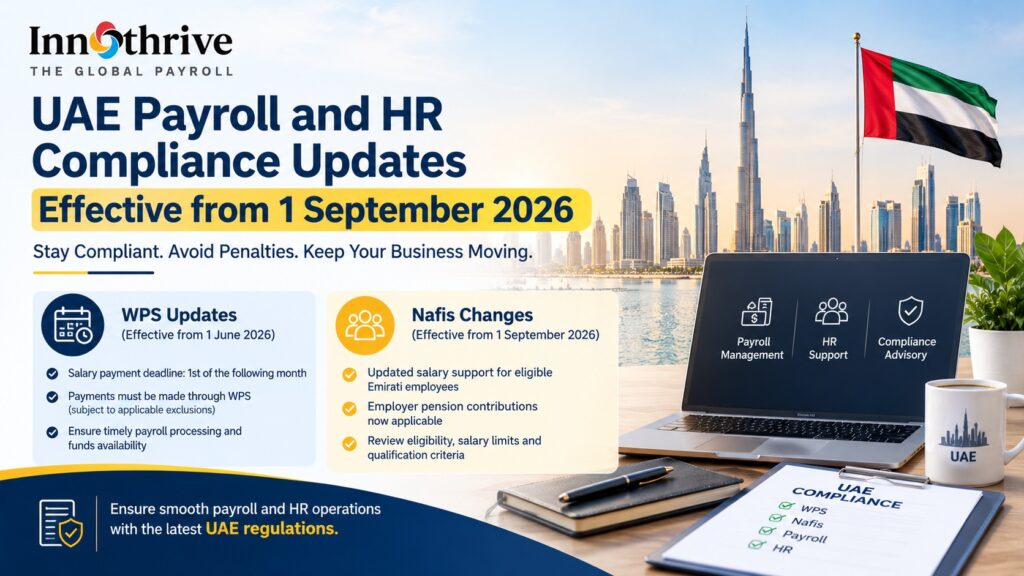
The official UAE Government portal confirms the updated WPS rules under Ministerial Resolution No. 340 of 2026. The Emirati Talent Competitiveness Council (ETCC) has also announced updates to Nafis taking effect from September 2026.
1. WPS salary-payment deadline
The revised WPS framework took effect on 1 June 2026, not 1 September 2026. However, the deadline for August 2026 wages fell on 1 September 2026.
| Requirement | What employers need to know |
| Salary deadline | Wages for the previous month are due on the first day of the following Gregorian month. |
| Payment channel | MoHRE-registered establishments must pay through WPS, subject to applicable exclusions. |
| Payroll planning | Payroll calculations, approvals, funding and payment instructions must be completed in advance. |
| Delayed payments | Payment after the prescribed due date is treated as delayed under the updated framework. |
What businesses should do: Set an internal payroll cut-off several working days before month-end, confirm funds are available, and verify that salary payments have actually been processed rather than assuming that submitting payment instructions is sufficient.
2. Nafis changes from September 2026
The ETCC has announced updates to the Nafis programme that affect salary-support calculations and pension-related costs for eligible UAE national employees. These changes are particularly relevant to businesses employing Emiratis in the private sector.
Changes payroll teams should review
- Emirati salary support
The updated salary-support mechanism applies to new beneficiaries from September 2026. Existing beneficiaries are subject to a phased adjustment, including automatic reductions of AED 500 every six months for specified groups, according to the updated eligibility arrangements. - Employer pension contributions
From September 2026, private-sector employers must account for their own share of pension contributions for Emirati employees covered by the relevant Nafis pension programme. Do not assume that Nafis will continue paying the employer’s share. Confirm the applicable pension fund rules and employee eligibility. - Salary and eligibility checks
Review the employee’s salary, educational qualification, Nafis beneficiary status and applicable support category. The revised scheme includes salary eligibility limits and different support levels by qualification, so payroll and HR records must be aligned with the employee’s current eligibility.
3. Which businesses are affected?
| Employer or workforce | Main compliance consideration |
| UAE mainland company registered with MoHRE | Follow the updated WPS payment timetable and related requirements. |
| Company employing eligible Emirati nationals | Review Nafis eligibility, support records and pension-contribution costs. |
| Free-zone company | Confirm the applicable employment authority and payroll rules; do not assume that every free zone follows the identical MoHRE process. |
| Company employing expatriates only | WPS and applicable employment requirements remain relevant; the Nafis changes primarily concern eligible Emirati employees. |
The UAE Government lists specific categories excluded from WPS compliance, so eligibility should be checked against the official rules rather than assumed.
4. Recommended action for payroll service providers
For a payroll outsourcing provider such as The Global Payroll, these developments create a need to review:
- Payroll management: Monthly payroll scheduling, WPS preparation, payment reconciliation and reporting.
- HRMS: Accurate employee records, salary components, deductions, employee nationality and eligibility data.
- Compliance support: Monitoring regulatory updates, maintaining payroll evidence and coordinating with the relevant authority or pension fund.
- Emirati employee payroll: Tracking applicable Nafis support separately from contractual salary and calculating employer pension costs correctly.
These are practical service recommendations based on the compliance requirements above, not a claim that the government requires every business to purchase outsourced payroll services.