








Consultant Payroll and EOR in USA
Consultant Payroll and EOR in USA — A Practical Guide to US Hiring
Expanding into the United States requires strict adherence to federal and multi-state payroll regulations, W-2 tax withholdings, 1099 contractor governance, and FLSA labor standards. Discover how structured EOR and consultant payroll solutions give global companies rapid, risk-free market entry.
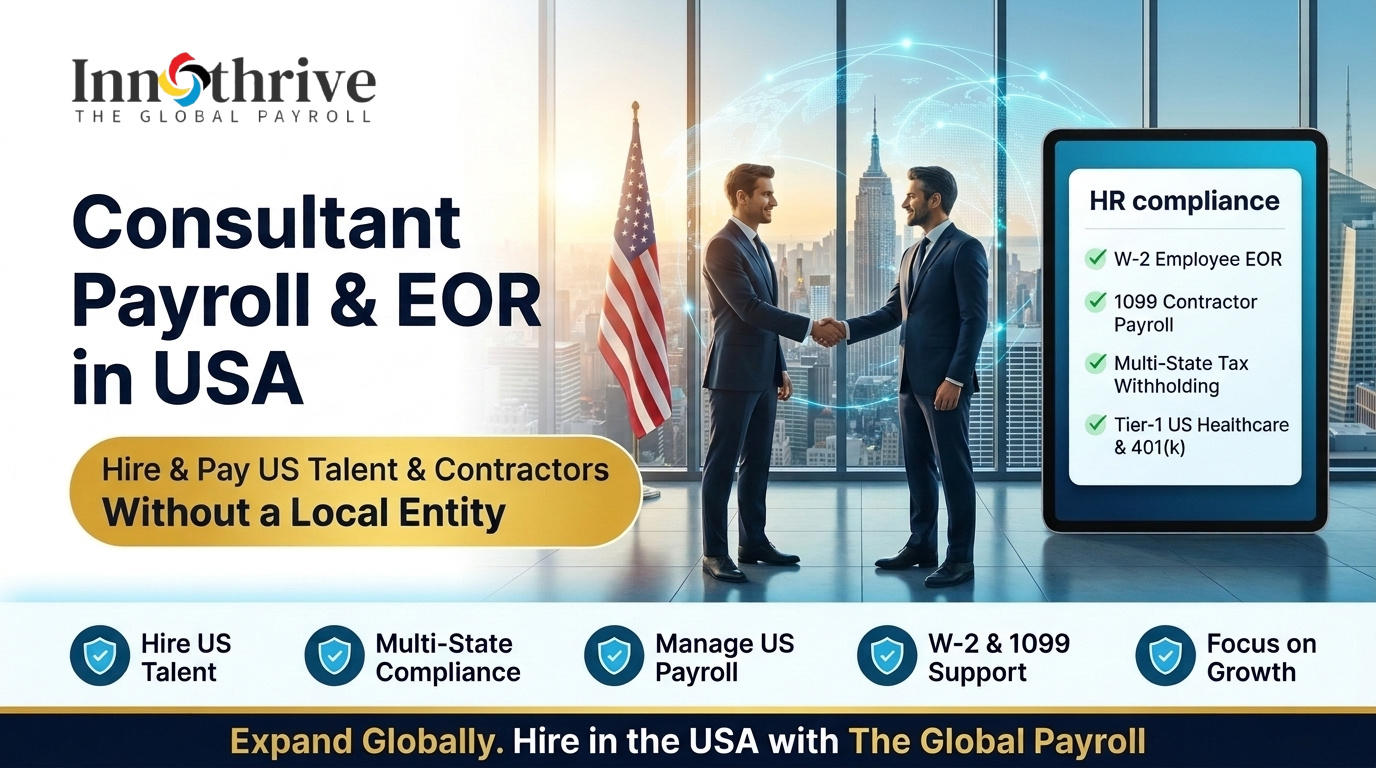
Navigating US Employment: EOR vs. Consultant Payroll
Expanding operations into the United States presents unparalleled commercial opportunities for global enterprises, tech firms, and Indian multinational companies. However, the United States possesses one of the most rigorously enforced employment regulatory environments in the world. Between the federal requirements of the U.S. Department of Labor (DOL) and individual state-level labor departments, international companies often struggle to navigate the legal complexities of hiring American talent.
When engaging talent in the USA, global organizations generally choose between two primary employment and payment pathways: an Employer of Record (EOR) for full-time W-2 employees, or Consultant Payroll for 1099 independent contractors. Selecting the correct structure is critical to avoiding devastating tax penalties, misclassification liabilities, and operational bottlenecks.
What Is an Employer of Record (EOR) in the USA?
An Employer of Record (EOR) in the USA is a third-party organization that serves as the legal employer of your American personnel on paper, while you maintain full day-to-day operational control over their tasks, deliverables, and performance. Under an EOR model:
- No US Legal Entity Required: You do not need to register a foreign qualification, incorporate a Delaware C-Corp or LLC, or navigate complex state tax registrations across multiple jurisdictions.
- Statutory W-2 Compliance: The EOR handles all mandatory Federal Insurance Contributions Act (FICA taxes — 6.2% Social Security + 1.45% Medicare), Federal Unemployment Tax (FUTA), State Unemployment Insurance (SUTA), and state workers’ compensation coverage.
- Tier-1 Employee Benefits: Top American talent expects competitive health, dental, vision, life, and 401(k) retirement benefits. An EOR leverages large group buying power to offer Fortune-500 level benefits that an overseas firm cannot easily secure on its own.
- Intellectual Property & Confidentiality Protection: Robust, state-compliant employment agreements guarantee that all IP, patents, and work products developed by US workers remain the exclusive property of your parent enterprise.
Scope of Consultant Payroll & EOR Solutions in the USA
Whether you are onboarding a nationwide enterprise sales team or paying strategic US advisors, our end-to-end service suite delivers turnkey compliance across all 50 states:
1. US W-2 Employer of Record (EOR)
Legally employ American professionals without establishing a US state LLC or C-Corp. We assume full statutory employer responsibilities across all 50 states.
2. 1099 Contractor & Consultant Payroll
Automated invoice verification, milestone disbursements, and statutory compliance for US-based independent contractors, freelancers, and technical consultants.
3. Multi-State Tax Withholding
Automated computation and withholding of Federal Income Tax (FIT), State Income Tax (SIT), Local Income Tax (LIT), and FICA (Social Security & Medicare).
4. Statutory Unemployment & Workers’ Comp
Management of Federal Unemployment Tax (FUTA), State Unemployment Tax (SUTA) rates across all 50 states, and state-mandated Workers’ Compensation insurance policies.
5. FLSA & Overtime Governance
Rigorous worker classification under Fair Labor Standards Act (FLSA) regulations (exempt vs non-exempt salaried and hourly wages) and state-specific daily/weekly overtime.
6. Form W-2 & 1099-NEC Annual Filings
Timely generation, distribution, and IRS/SSA electronic filing of employee Form W-2s and contractor Form 1099-NECs before the strict statutory January 31 deadline.
7. Comprehensive US Employee Benefits
Access to competitive Tier-1 US medical, dental, and vision insurance plans, 401(k) retirement plans, HSA/FSA accounts, and mandatory state disability benefit plans.
8. Cross-Border Invoicing & FX Settlement
Transparent single-currency billing in USD, EUR, GBP, or INR with competitive FX rates, eliminating unpredictable international wire fees and multi-currency banking friction.
Comparative Analysis: US EOR vs. 1099 Consultant vs. US Entity
Understanding the structural, cost, and legal differences between hiring models is vital before signing offer letters or consulting retainers:
| Evaluation Criteria | US Employer of Record (W-2) | Consultant Payroll (1099) | Direct US Legal Entity |
|---|---|---|---|
| Legal Employment Status | Full W-2 Employee employed via local US EOR | 1099 Independent Contractor (B2B Retainer) | Full W-2 Employee employed by your own US entity |
| Time-to-Hire & Onboard | 48 – 72 Hours (Instant hiring ready) | 24 – 48 Hours (Contract sign-off) | 2 – 4 Months (State filings, EIN, bank setup) |
| Tax Withholding & Reporting | EOR handles FIT, FICA, SIT, LIT, SUTA & Form W-2 | No withholding; Form 1099-NEC issued annually | Company must register in each state & file quarterly |
| Misclassification Risk | Zero Risk (Fully indemnified W-2 classification) | Moderate to High if work is core & controlled | Zero Risk (Company manages directly) |
| Benefits & Health Insurance | Comprehensive group healthcare, dental, 401(k) | No statutory benefits provided | Must procure separate group insurance policies |
| Best Suited For | Core staff, full-time sales executives, key engineers | Short-term projects, specialized advisors, fractional roles | Long-term expansion with 30+ US employees |
Critical US Compliance Pitfalls to Avoid
Foreign organizations expanding into the US frequently encounter severe regulatory traps that result in retroactive tax assessments and legal disputes:
- Worker Misclassification (1099 vs W-2): The IRS and Department of Labor aggressively audit companies that treat full-time core workers as “1099 independent contractors” to evade payroll taxes and benefits. Misclassification can trigger retroactive FICA taxes, unpaid overtime claims, statutory interest, and heavy civil penalties.
- Multi-State Nexus & “Nexus Traps”: In the US, each of the 50 states maintains its own payroll, withholding, and workers’ compensation laws. Having even a single remote employee working from California, New York, or Texas creates corporate tax nexus in that state, requiring localized payroll filings.
- At-Will Employment Nuances: While employment is generally “at-will” in 49 states (excluding Montana), terminations must strictly comply with federal anti-discrimination statutes (Title VII, ADA, ADEA) and state-specific final pay rules (e.g., California requires immediate final pay on the day of termination).
- Permanent Establishment (PE) Risk: Employing commercial sales agents who habitually negotiate and conclude contracts on US soil can create a Permanent Establishment under international double taxation avoidance agreements (DTAA), exposing foreign parent companies to federal corporate income taxes.
- FLSA Exemption Criteria: Paying a worker on a fixed salary does not automatically exempt them from overtime pay. Workers must satisfy strict Department of Labor salary thresholds and primary duty tests (Executive, Administrative, or Professional exemption).
Why Choose The Global Payroll for US Operations?
The Global Payroll (an enterprise brand of Innothrive Solutions) provides complete cross-border workforce management, international payroll, and statutory advisory services. We bridge the operational gap between global corporate headquarters and local US talent:
- Full 50-State Coverage: Whether your personnel are located in technology hubs like Silicon Valley and Austin or distributed across remote states, we handle multi-state withholding and local tax filings seamlessly.
- Dual Model Flexibility: Easily migrate workers between 1099 consulting agreements and full-time W-2 EOR employment as your commercial relationship and workload mature.
- Consolidated Cross-Border Invoicing: Eliminate the headache of managing separate bank accounts and currency conversions. Receive one unified monthly invoice covering payroll, tax withholdings, and statutory benefits.
- Synchronized Global Ecosystem: Manage your US workforce alongside talent in India, the UK, Europe, Southeast Asia (Philippines, Indonesia, Singapore), and Africa from a single trusted partner. Explore our related Employer of Record Services and EOR vs Consultant Comparison Guide.
Frequently Asked Questions (FAQ)
Expand Your Business into the United States with Complete Confidence
Hiring American talent shouldn’t require months of complex legal entity setup. Partner with The Global Payroll for compliant W-2 Employer of Record solutions and streamlined 1099 consultant payroll across all 50 US states.
Direct Consultation: info@theglobalpayroll.com | Helpline: +91 9667107217