








Payroll Services in Indonesia
Payroll Services in Indonesia — A Guide to Outsourced Payroll
Payroll in Indonesia requires a disciplined process for employee compensation, PPh 21 income-tax calculations, BPJS social security contributions, and THR payments. Discover how outsourced payroll management provides accurate, audit-ready operations without losing financial visibility.
Disciplined Payroll Administration in Indonesia
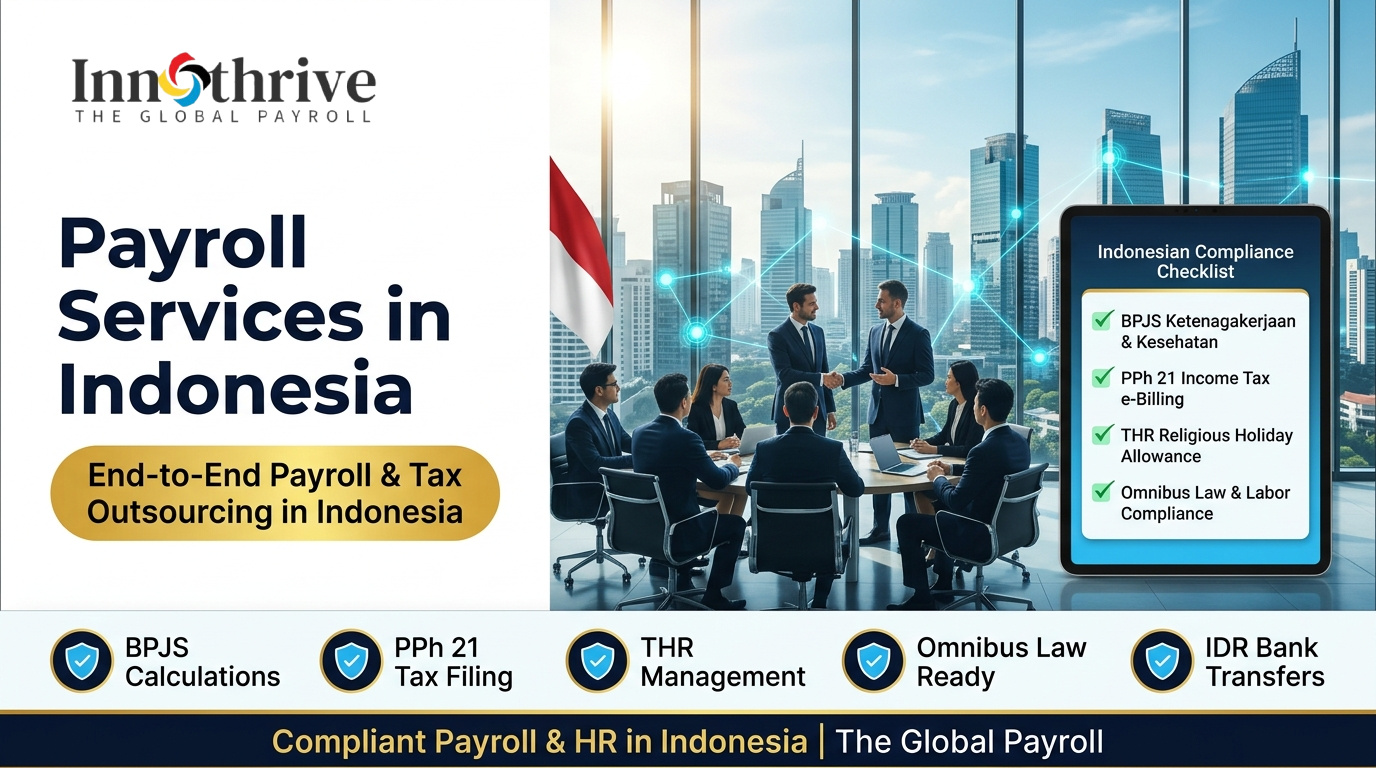
Executing payroll in Indonesia requires a disciplined, highly structured process. Compensation management extends far beyond gross-to-net pay runs: employers must navigate dynamic employee tax brackets under PPh 21, mandatory dual-tier social security contributions across BPJS Kesehatan and BPJS Ketenagakerjaan, religious holiday pay obligations, and strict statutory reporting calendars.
Statutory calculations often vary based on employment tenure, contract classifications (PKWT fixed-term vs. PKWTT permanent), geographical minimum wage decrees, and residency status (domestic residents vs. expatriates). For growing enterprises expanding into Jakarta, Bali, Surabaya, or across the archipelago, outsourced payroll provides organizational rigor, compliance security, and executive financial transparency.
What is Payroll Outsourcing in Indonesia?
Payroll outsourcing is an operational partnership where an employer appoints a specialized external partner to manage recurring payroll functions. Depending on the agreed scope, this encompasses gathering monthly attendance and salary inputs, executing gross-to-net pay computations, generating digital payslips, building payroll registers, calculating tax and social security withholdings, and delivering reconciliation files for finance leadership.
Governance & Boundaries: Engaging an outsourced payroll provider does not absolve corporate leadership of its statutory liabilities under Indonesian labor and tax law. A robust service agreement strictly defines roles: establishing who provides employee master data, who conducts internal verification, who approves fund disbursements, who files statutory returns with official portals, and how personnel records are securely archived.
Comprehensive Scope: Payroll Services You May Require
A structured Indonesian payroll engagement adapts to your operational scale, legal entity structure, and banking workflows. Core service components include:
1. Monthly Payroll Processing
Comprehensive gross-to-net pay runs utilizing validated attendance, leave, overtime, and compensation inputs based on an agreed monthly cut-off calendar.
2. Salary & Premium Calculations
Automated computation of fixed and variable allowances, overtime pay under statutory multipliers, meal/transport stipends, reimbursements, and adjustments.
3. Payslips & Payroll Registers
Generation of confidential bilingual (English & Bahasa Indonesia) digital payslips, detailed payroll registers, and automated bank disbursement upload batches.
4. PPh 21 Withholding Tax Support
Precise calculation of monthly employee withholding tax under the TER (Tarif Efektif Rata-Rata) mechanism (PP 58/2023) and year-end annual tax reconciliation.
5. BPJS Social Security Computation
Accurate contribution splits for BPJS Kesehatan (healthcare) and BPJS Ketenagakerjaan (JHT, JKK, JKM, JP, and JKP) taking into account statutory salary ceilings.
6. Religious Holiday Allowance (THR)
Statutory entitlement computation and disbursement coordination for Tunjangan Hari Raya (THR) mandated under Permenaker No. 6/2016.
7. Lifecycle & Severance Calculations
New-hire prorations, salary adjustments, and termination final-pay processing including severance (UP), long-service pay (UPMK), and compensation rights (UPH).
8. Reconciliations & Audit Support
Cycle-to-cycle variance analyses, general ledger journal mapping, departmental cost allocations, and statutory audit-ready documentation packages.
Scope Transparency Notice: A professional proposal explicitly differentiates between calculation support, preparation of statutory schedules, and actual execution of bank transfers or agency electronic filings. Setting transparent operational boundaries upfront prevents compliance bottlenecks and ensures audit readiness.
Indonesian Payroll Compliance: Core Regulatory Pillars
Indonesian payroll compliance centers around three vital regulatory axes: compensation withholding tax (PPh 21/26), universal healthcare and social security (BPJS), and mandatory religious holiday allowances (THR). Below is the comprehensive compliance architecture employers must observe:
| Regulatory Pillar | Statutory Requirement | Calculation & Compliance Rules | Non-Compliance Risk |
|---|---|---|---|
|
PPh 21 / PPh 26 Directorate General of Taxes (DGT) | Mandatory employee income tax withholding on salaries, allowances, and bonuses. Governed by the Harmonized Tax Law (UU HPP) and PP 58/2023. | Calculated monthly using Effective Average Tax Rate (TER Categories A, B, C) based on marital/dependent status (PTKP), with year-end annual true-up (Form 1721-A1). | Tax interest penalties (benchmark interest rate + uplift per month), administrative fines, and DGT tax audit scrutiny. |
|
BPJS Kesehatan Healthcare Social Security | Mandatory universal social healthcare insurance covering medical, hospital, and clinical services for employees and immediate family dependents. | Total 5.0% of monthly salary (4.0% employer contribution, 1.0% employee deduction), capped at maximum salary base of IDR 12,000,000 per month. | Suspension of public administrative services, monthly penalty interest on late payments, and employee healthcare claim denial. |
|
BPJS Ketenagakerjaan Employment Social Security | Mandatory social security covering work injury (JKK), death (JKM), old-age provident funds (JHT), pension (JP), and job loss (JKP). |
• JHT: 5.7% (3.7% employer, 2.0% employee) • JP: 3.0% (2.0% employer, 1.0% employee, cap IDR 10,042,300) • JKK: 0.24%–1.74% (employer paid based on risk level) • JKM: 0.3% (employer paid) | 2% monthly penalty on unpaid dues, legal sanctions under Law No. 24/2011, and corporate officer liability. |
|
Tunjangan Hari Raya (THR) Religious Holiday Allowance | Mandatory annual non-wage statutory allowance under Minister of Manpower Regulation (Permenaker) No. 6/2016 for all employees with 1+ month of service. | Equal to 1 month’s basic salary + fixed allowances for 12+ months service (pro-rated for 1–12 months). Strictly payable at least 7 days before the designated religious holiday. | 5% fine on total THR due, Ministry of Manpower (Kemnaker) inspection orders, and administrative business restriction sanctions. |
|
Indonesian Labor Law Standards Job Creation Act (Law No. 6/2023) | Adherence to regional minimum wage rates (UMP/UMK), working hours (40 hrs/wk), overtime compensation, annual leave (12 days), and statutory severance (PP 35/2021). | Overtime calculated at 1.5x hourly wage for 1st hour and 2x for subsequent hours. Severance components include standard severance (UP), long-service pay (UPMK), and rights compensation (UPH). | Industrial dispute litigation, monetary back-pay awards, and civil penalties for underpayment below provincial wage decrees. |
Official Portals for Regulatory Verification:
Employers should regularly cross-verify tax and social security assumptions against official Indonesian government documentation portals:
- Directorate General of Taxes (DGT): https://www.pajak.go.id/
- Ministry of Finance Legal Documentation (JDIH Kemenkeu): https://jdih.kemenkeu.go.id/
- BPJS Kesehatan (Social Healthcare): https://www.bpjs-kesehatan.go.id/
- BPJS Ketenagakerjaan (Employment Security): https://www.bpjsketenagakerjaan.go.id/
Strategic Advantages of Outsourcing Payroll in Indonesia
Delegating payroll administration to seasoned specialists converts administrative complexity into a predictable, automated business function:
- Disciplined Workflow & Cut-Off Schedules: Enforces structured submission deadlines and validation milestones, eliminating delayed salary disbursements.
- Granular Financial & Variance Reporting: Delivers comprehensive gross-to-net summaries, departmental cost allocations, and employer contribution registers that sync directly with enterprise general ledgers.
- Seamless Employee Lifecycle Administration: Manages new hires, mid-cycle adjustments, prorations, unpaid leaves, and end-of-service severance packages without overburdening internal HR.
- Minimized Compliance & Audit Risks: Automated calculation models eliminate spreadsheet formula corruption, preventing expensive tax under-withholding surcharges and BPJS late penalties.
- Agile Regional Scalability: Easily supports business expansion from a small representative office to large operational hubs across multiple Indonesian cities and regional offices.
Evaluating an Indonesian Payroll Partner: Essential Criteria
When evaluating potential service providers, corporate decision-makers should scrutinize expertise, compliance monitoring, and data confidentiality:
- Local Regulatory Competence: Does the provider maintain direct in-country specialists or verified local partners capable of interpreting rapid statutory shifts (e.g. PP 58/2023 TER tax revisions)?
- Data Protection Compliance: How is confidential payroll, salary, and banking information safeguarded? Does the partner adhere to Indonesia’s Personal Data Protection Law (UU No. 27/2022 / PDP Law)?
- Bilingual Capability & Support: Can the provider generate employee payslips and compliance documentation in both English and Bahasa Indonesia?
- Error Rectification & Escalation Matrix: Are clear service level agreements (SLAs), response times, and dispute resolution workflows formalized in the agreement?
- Multi-Country Reporting: For regional enterprises, can Indonesian payroll data be rolled up into standardized consolidated reporting formats alongside other Asian territories?
How The Global Payroll Supports Your Indonesian Operations
The Global Payroll (an enterprise brand of Innothrive Solutions) provides structured cross-border payroll administration, processing governance, and reporting solutions tailored for modern international organizations.
We evaluate your company’s headcount, compensation structure, employee classifications, and internal software stack to craft a bespoke scope of work. For Indonesian engagements, we establish unambiguous responsibility lines across calculation, reporting, filing support, and payment execution. Our implementation framework includes structured parallel runs, rigorous data validation, and documented sign-offs, guaranteeing a seamless transition to live operations.
Frequently Asked Questions (FAQ)
Ready to Streamline Your Indonesia Payroll Operations?
Ensure total compliance with PPh 21, BPJS Kesehatan, BPJS Ketenagakerjaan, and THR regulations while delivering accurate, on-time salary disbursements. Contact our cross-border payroll specialists today for a tailored proposal.
Request a Tailored Proposal →