








Payroll Services in South Africa
Payroll Services in South Africa — A Guide to Payroll Outsourcing
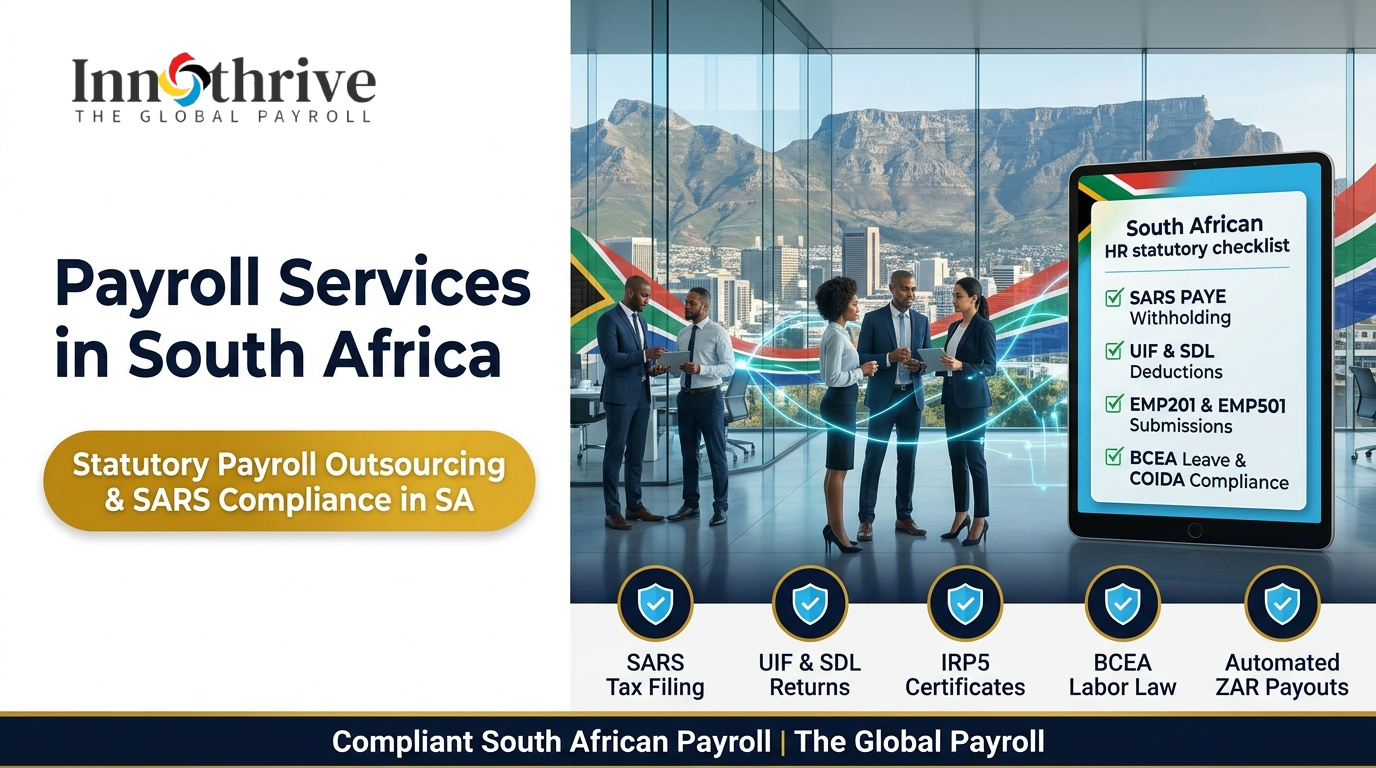
Payroll in South Africa requires strict adherence to PAYE withholding, UIF contributions, SDL levies, and SARS EMP201 / EMP501 reporting. Discover how structured payroll outsourcing gives your leadership audit-ready compliance without operational friction.
Disciplined Payroll Administration in South Africa
Executing payroll in South Africa demands a rigorous, highly disciplined operational framework. Beyond basic gross-to-net salary disbursements, employers must navigate dynamic Pay-As-You-Earn (PAYE) income tax brackets, Unemployment Insurance Fund (UIF) monthly deductions, Skills Development Levies (SDL), and strict submission timetables with the South African Revenue Service (SARS) and Department of Employment and Labour.
As headcounts expand, managing employee starters, leavers, travel allowances, medical scheme credits, and statutory year-end tax reconciliations (EMP501 / IRP5) can become an administrative bottleneck. Partnering with a specialized payroll outsourcing firm establishes a repeatable, audit-ready operating framework that ensures complete regulatory compliance while giving executive leadership transparent financial visibility.
What is Payroll Outsourcing in South Africa?
Payroll outsourcing is a collaborative arrangement in which an organization engages a dedicated external service provider to manage agreed payroll processing and administration tasks. Depending on the agreed scope of work, this encompasses capturing monthly changes, computing gross-to-net calculations, generating BCEA-compliant payslips, compiling payroll registers, calculating tax withholdings, and preparing statutory declarations for SARS.
Governance & Legal Distinction: Outsourcing operational workflows does not remove corporate legal responsibility under South African law. A comprehensive service agreement clearly defines operational boundaries: specifying who supplies raw attendance and salary data, who approves calculations, who releases bank disbursement batches, who submits official declarations via SARS eFiling, and who preserves historical employment records.
Scope of Services Commonly Included in South African Payroll
A structured South African payroll service is customized to your corporate structure, banking platform, and reporting needs:
1. Monthly Gross-to-Net Processing
Comprehensive monthly payroll pay runs executing gross-to-net calculations based on approved attendance, leave, and compensation inputs.
2. BCEA-Compliant Digital Payslips
Preparation and secure digital delivery of confidential payslips itemising all statutory details required under the Basic Conditions of Employment Act (BCEA).
3. Overtime, Bonuses & Leave
Automated calculation of overtime premiums (1.5x regular hourly wage / 2x Sunday rate), production bonuses, travel allowances, leave encashment, and unpaid leave.
4. PAYE Employees’ Tax Calculations
Accurate PAYE withholding computations incorporating progressive tax brackets, age-dependent tax rebates, and Medical Scheme Fees Tax Credits (MTC).
5. UIF & Skills Development Levy (SDL)
Exact computation of Unemployment Insurance Fund (UIF) contributions subject to monthly salary caps, and 1% employer Skills Development Levy (SDL) where applicable.
6. Monthly SARS EMP201 Declarations
Preparation and reconciliation of monthly EMP201 employer return schedules (PAYE, SDL, UIF, and ETI) ensuring compliance with the monthly 7th filing deadline.
7. EMP501 Reconciliations & IRP5s
Preparation support for bi-annual and annual SARS EMP501 reconciliations via e@syFile/eFiling, and accurate generation of employee IRP5/IT3(a) tax certificates.
8. Departmental Cost & Audit Schedules
Granular payroll registers, general ledger journal mapping files, cost-centre allocation summaries, and starter/leaver termination package calculations.
Service Clarity Notice: In South African payroll administration, payroll processing and schedule preparation must be formally distinguished from statutory submission via SARS e@syFile / eFiling and bank payment execution. Setting clear operational boundaries upfront avoids compliance bottlenecks and ensures transparent governance.
South African Payroll Compliance: Core Regulatory Framework
Employers operating in South Africa must maintain strict alignment with regulatory requirements overseen by SARS and the Department of Employment and Labour:
| Statutory Pillar | Statutory Requirement | Calculation & Compliance Rules | Non-Compliance Risk |
|---|---|---|---|
|
SARS PAYE South African Revenue Service | Mandatory withholding of employees’ tax from remuneration under the Fourth Schedule to the Income Tax Act No. 58 of 1962. | Computed on graduated progressive tax tables (18% to 45%) after applying age-based primary, secondary, and tertiary tax rebates and Medical Scheme Fees Tax Credits (MTC). | 10% late payment penalty, compounding interest, and personal liability for company directors under the Tax Administration Act. |
|
UIF Contributions Unemployment Insurance Fund | Compulsory social insurance providing unemployment, illness, maternity, adoption, and dependant benefits under the Unemployment Insurance Contributions Act 2002. | Total contribution of 2.0% of remuneration (1.0% employer contribution, 1.0% employee deduction), capped at statutory monthly earnings ceiling of ZAR 17,712 (max ZAR 177.12 each). | 10% penalty on outstanding amounts plus interest; non-compliance blocks issuance of Department of Labour compliance certificates. |
|
Skills Development Levy (SDL) Skills Development Levies Act 1999 | Mandatory statutory levy to fund workforce skills development and training programs across Sector Education and Training Authorities (SETAs). | 1.0% of total leviable payroll paid exclusively by the employer. Exempt if total leviable remuneration is less than ZAR 500,000 per 12-month period or qualifying public benefit body. | 10% late payment penalty, SARS interest, and disqualification from claiming SETA mandatory training grant disbursements. |
|
Monthly EMP201 Return SARS Monthly Payment Declaration | Monthly declaration and payment remittance of PAYE, SDL, UIF, and Employment Tax Incentive (ETI) liabilities to SARS. | Must be submitted and paid via SARS eFiling strictly on or before the 7th of the following month (or the preceding business day if the 7th falls on a weekend/holiday). | Immediate 10% late payment penalty, forfeiture of ETI claims, and compromised SARS tax compliance status (TCS PIN). |
|
EMP501 & IRP5 Reconciliation Bi-Annual & Annual Employer Filing | Bi-annual interim reconciliation (March to August, due October 31) and annual final reconciliation (March to February, due May 31). | Reconciles EMP201 payments against actual employee IRP5/IT3(a) certificates via SARS e@syFile or eFiling, validating tax numbers and remuneration codes. | Penalties of up to 1% of total employer annual payroll value for each month the reconciliation remains unsubmitted. |
|
BCEA Labor Standards Department of Employment & Labour | Basic Conditions of Employment Act No. 75 of 1997 governing working hours, overtime, leave entitlements, termination notice, and written payslips. | Max 45 ordinary hours/week; overtime at 1.5x regular pay (max 10 hrs/wk); minimum 21 consecutive days annual leave (or 1 day per 17 days worked); sick leave cycles. | CCMA arbitration dispute awards, Department of Labour compliance orders, and statutory back-pay orders. |
Official Government Portals for Regulatory Verification:
Tax brackets, medical scheme credit thresholds, and employer declaration deadlines should be continuously verified against official sources:
- South African Revenue Service (SARS): https://www.sars.gov.za/
- Department of Employment and Labour: https://www.labour.gov.za/
Strategic Benefits of Outsourcing Payroll in South Africa
For growing small-to-mid-sized enterprises, international corporations with South African branches, and firms operating lean finance functions, outsourcing payroll converts administrative complexity into a predictable operational advantage:
- Enforced Payroll Calendar & Strict Cut-Off Dates: Imposes predictable submission windows, approval checkpoints, and payment milestones, eliminating late salary disbursements.
- Consistent BCEA-Compliant Employee Payslips: Provides clear, standardized electronic payslips that detail all mandatory basic salary, allowance, overtime, and deduction elements.
- Seamless General Ledger & Accounting Reconciliations: Generates gross-to-net reconciliation reports and journal allocation files that integrate cleanly with internal accounting ledgers.
- Standardized Starter, Leaver & Termination Administration: Manages employee onboarding, mid-month prorations, notice pay, leave encashments, and severance pay without taxing internal HR staff.
- Agile Workforce Scalability: Easily adapts as your workforce expands from a dozen staff to hundreds of employees across multiple locations without increasing in-house payroll overhead.
Evaluating a South African Payroll Provider: Key Criteria
Corporate leaders evaluating potential service partners should examine technical capability, data protection, and service continuity:
- SARS Technical Competence: Does the provider maintain direct expertise in SARS eFiling, e@syFile, EMP201 monthly declarations, and bi-annual EMP501 reconciliation processes?
- Data Protection & POPIA Compliance: How is confidential payroll, identity, and banking information protected? Does the partner adhere to South Africa’s Protection of Personal Information Act (POPIA / Act 4 of 2013)?
- Operational Responsibility Delineation: Does the engagement clearly identify whether the partner prepares statutory schedules or executes direct submission and bank payments?
- Service Level Agreements & Escalation: Are turnaround times, error rectification protocols, and escalation contacts formally documented in writing?
- Multi-Country Reporting Integration: For multinational organizations, can South African payroll data be rolled up into consolidated multi-territory reporting while retaining local drill-down detail?
How The Global Payroll Supports Your Business
The Global Payroll (an enterprise brand of Innothrive Solutions) delivers structured cross-border payroll administration, operational governance, and reporting solutions tailored for modern businesses.
For South African operations, we evaluate your workforce size, remuneration structure, and internal software stack to propose a transparent, scoped operating model. Our implementation roadmap includes comprehensive discovery, payroll data validation, test parallel runs, and documented sign-offs, guaranteeing a secure, error-free transition to live payroll processing.
Frequently Asked Questions (FAQ)
Ready to Streamline Your South Africa Payroll Operations?
Ensure complete compliance with SARS PAYE, UIF, SDL, and BCEA standards while delivering accurate, on-time salary disbursements for your workforce. Contact our cross-border payroll specialists today for a customized proposal.
Request a Scoped Proposal →