







Payroll Services in the Philippines
Payroll Services in the Philippines — A Practical Guide to Payroll Outsourcing
Managing payroll in the Philippines involves more than calculating monthly salaries. Discover how structured outsourcing delivers end-to-end statutory compliance, accuracy, and operational agility for global and local businesses.
Understanding Payroll Administration in the Philippines
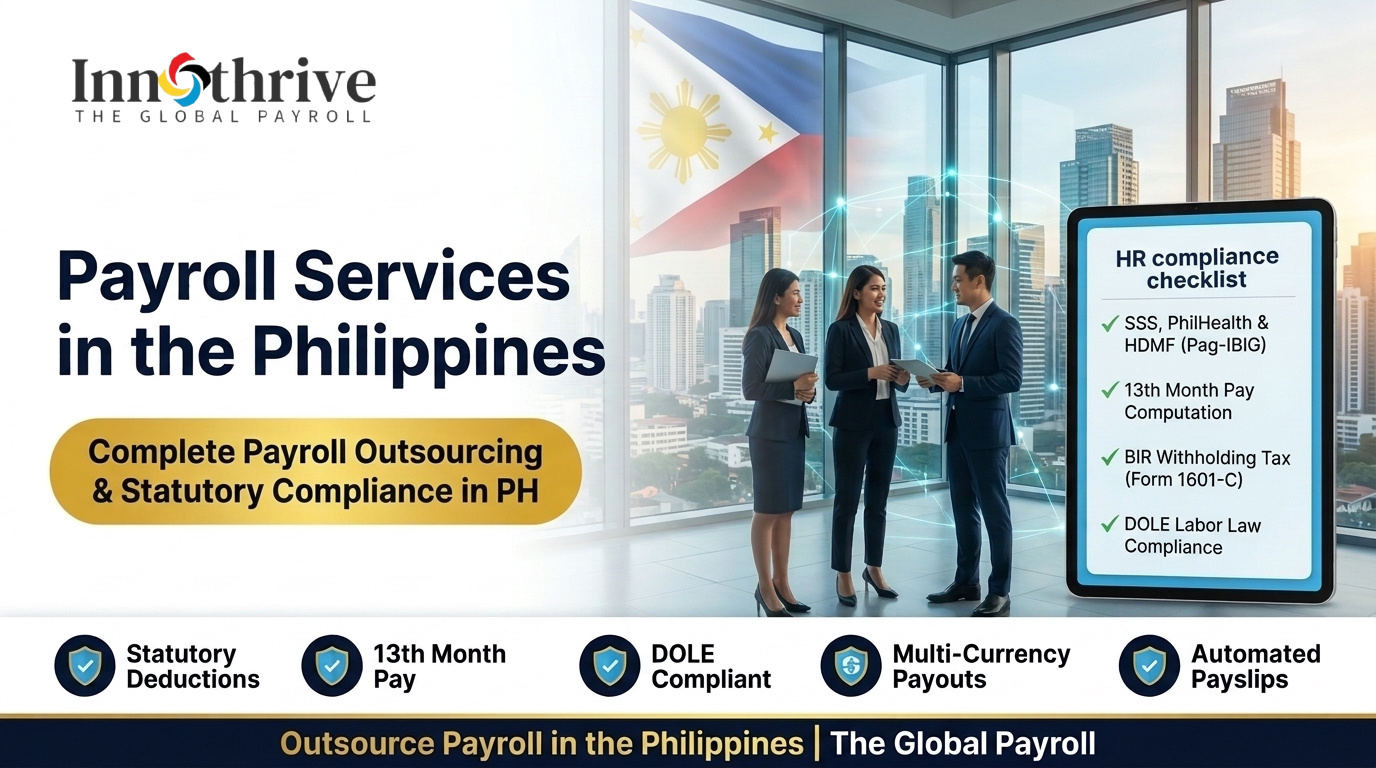
Managing payroll operations in the Philippines involves significantly more than simply calculating monthly salaries. For organizations operating in or expanding into the country, payroll demands meticulous coordination of employee master records, daily time records (DTR), shift differentials, leave entitlements, statutory withholding taxes, social security remittances, and multi-agency reporting.
As your workforce expands, these recurring administrative and regulatory demands consume critical bandwidth from internal finance and HR leaders. Engaging an experienced payroll outsourcing partner provides a structured, repeatable, and scalable operating framework that preserves full managerial oversight while de-risking statutory compliance.
What Are Payroll Outsourcing Services?
Payroll outsourcing is a collaborative arrangement where an organization engages an external specialist to execute some or all of its ongoing payroll administration. Depending on the agreed scope of work, the provider collects attendance and compensation inputs, executes gross-to-net calculations, generates payslips, prepares statutory deduction schedules, and compiles audit-ready reporting.
Crucial Governance Distinction: The employer remains legally accountable for its statutory obligations under Philippine law unless a specific responsibility is lawfully delegated under a compliant service contract. A well-designed service level agreement (SLA) establishes clear boundaries: who supplies attendance data, who validates calculations, who authorizes fund releases, who submits official returns, and who maintains historical records.
What Can Payroll Services in the Philippines Include?
A professional payroll outsourcing solution is modular and adapted to your corporate operating model. The standard scope of services typically encompasses:
1. Bi-Monthly & Monthly Processing
Execution of standard Philippine semi-monthly payroll cycles (typically cut-offs on the 15th and 30th/31st of each month) or consolidated monthly pay runs.
2. Salary & Premium Calculations
Automated computation of basic pay, overtime, night shift differential, rest day, special non-working and regular holiday premiums, and allowances.
3. Payslip Preparation & Registers
Generation of secure password-protected digital employee payslips, comprehensive gross-to-net payroll registers, and bank disbursement upload files.
4. Statutory Withholding Support
Precise calculation support for BIR compensation withholding tax (TRAIN Law), SSS contributions, PhilHealth premiums, and Pag-IBIG savings.
5. Finance Variance & Reconciliation
Detailed cycle-over-cycle variance reports, general ledger journal mapping, and headcount cost allocation reports prepared for internal finance audits.
6. Onboarding & Final-Pay Processing
New-hire setup, mid-month joining proration, clearance workflows, leave monetization, separation pay calculation, and final tax computation.
7. 13th-Month Pay & Year-End Tax
Mandatory 13th-month pay computation, annual tax annualization, and preparation of statutory annual employee tax forms (BIR Form 2316).
8. Compliance Calendars & Security
Enforced payroll cut-off schedules, approval checkpoints, encrypted employee records, and data handling compliant with the Philippine Data Privacy Act.
Note on Service Clarity: In Philippine payroll practice, payroll calculation, preparation of statutory remittance reports, and actual fund disbursement or agency submission are distinct activities. A transparent service agreement explicitly delineates which of these phases are executed by the provider and which remain within your finance team’s approval matrix.
Philippines Payroll Compliance: Core Areas Employers Must Monitor
Employers with employees in the Philippines operate within an active regulatory framework overseen by multiple government bodies. Contribution bases, deduction ceilings, tax brackets, and mandatory filings require continuous vigilance:
| Regulatory Pillar | Statutory Requirement | Calculation & Compliance Rules | Non-Compliance Risk |
|---|---|---|---|
|
BIR Withholding Tax Bureau of Internal Revenue | Monthly withholding tax on compensation remitted via BIR Form 1601-C; year-end annualization and issuance of BIR Form 2316 to employees. | Graduated tax table under the Tax Reform for Acceleration and Inclusion (TRAIN) Law; mandatory exemption on the first ₱250,000 annual compensation and ₱90,000 de minimis/13th-month cap. | 25% surcharge, 12% annual interest, plus compromise penalties for late or fraudulent returns. |
|
SSS Contributions Social Security System (RA 11199) | Compulsory social insurance providing retirement, disability, sickness, maternity, and death benefits for private sector employees. | Tiered percentage split between employer and employee based on Monthly Salary Credit (MSC), including mandatory Workers’ Investment and Savings Program (WISP) and EC. | 2% monthly penalty on delinquent contributions; potential criminal liability for corporate officers. |
|
PhilHealth Universal Health Care Act (RA 11223) | Mandatory social health insurance program providing universal medical coverage for Philippine employees and their dependents. | Premium rate currently pegged at 5.0% of the employee’s monthly basic salary, shared equally (50% employer / 50% employee) with defined income floor and ceiling. | Monthly interest surcharges, withholding of hospital claim eligibility for staff, and administrative audit sanctions. |
|
Pag-IBIG Fund Home Development Mutual Fund (RA 9679) | National savings program providing housing financing, emergency calamity loans, and short-term provident benefits. | Mandatory contributions matching employee and employer portions up to maximum statutory monthly caps (currently ₱200 each per month). | Penalty of 1/10 of 1% per day of delay on unpaid dues; disqualification of employee loan privileges. |
|
13th-Month Pay Presidential Decree No. 851 | Mandatory statutory compensation benefit for all rank-and-file employees who have worked at least one month during the calendar year. | Must equal at least 1/12th of the total basic salary earned during the year; strictly payable on or before December 24 of each year. | Severe labor dispute complaints filed with DOLE; mandatory back-pay plus interest, labor audits, and legal liabilities. |
|
DOLE Labor Standards Labor Code of the Philippines | Regional minimum wage compliance (RTWPBs), overtime, night differential (10%), holiday premiums (up to 200%), and Service Incentive Leave (SIL). | Regional Wage Orders mandate minimum pay per region (NCR has highest rate); SIL mandates 5 days paid leave per year for employees with 1+ year service. | DOLE compliance orders, suspension of business permits, mandatory monetary awards, and double indemnity fines. |
Strategic Advantages: Why Growing Businesses Outsource Payroll
For fast-growing domestic companies, startups, and international enterprises managing remote or offshore teams, outsourcing payroll bridges the gap between rapid workforce expansion and stringent statutory compliance:
- Predictable Schedules & Enforced Cut-Offs: Establishes clear submission calendars, validation cycles, and payment dates, preventing last-minute salary disbursement scrambles.
- Reduced Operational Errors: Replaces fragile, error-prone manual spreadsheets with standardized calculation algorithms and rigorous multi-tier reconciliations.
- Complete Financial Transparency: Delivers granular gross-to-net cost breakdowns, departmental variances, and accrual reports that integrate smoothly with your general ledger.
- Seamless Employee Lifecycle Management: Handles onboarding, mid-month proration, allowances, leave monetization, and end-of-service final pay without adding HR headcount.
- Agile Scalability: Easily scales from 5 to hundreds of employees across multiple branches or remote locations without the overhead of expanding an in-house payroll department.
How to Choose a Reliable Payroll Provider in the Philippines
Selecting a payroll outsourcing partner requires examining governance, security, and local regulatory expertise. Key factors to evaluate before signing an engagement include:
- Input & Approval Workflows: How are attendance records, overtime hours, and salary adjustments gathered, validated, and formally authorized before processing?
- Delivery Model & Jurisdiction: Does the provider offer direct in-country delivery, collaborate with accredited local partners, or administer processing from a regional center of excellence?
- Statutory Filing Remit: Does the scope include statutory schedule preparation only, or does it extend to end-to-end filing and bank remittance with BIR, SSS, PhilHealth, and Pag-IBIG?
- Data Protection & Privacy Safeguards: How is confidential payroll data secured in transit and at rest? Does the provider comply with Republic Act No. 10173 (Philippine Data Privacy Act of 2012)?
- SLA & Business Continuity: Are turnaround times, error rectification protocols, escalation matrices, and disaster recovery procedures clearly documented in the service contract?
How The Global Payroll Supports Your Philippine Operations
The Global Payroll (an enterprise brand of Innothrive Solutions) delivers structured, audit-ready payroll outsourcing and cross-border HR administration for businesses expanding across Asia and globally. We partner with your executive leadership to design a tailored operating scope that fits your corporate governance model.
For engagements covering the Philippines, we ensure complete operational transparency: establishing whether calculations, reporting, filings, and disbursements are executed directly or in coordination with qualified in-country specialists. Our focus is delivering a predictable, repeatable payroll engine with documented inputs, multi-level review gates, and financial visibility that empowers your HR and finance teams.
Frequently Asked Questions (FAQ)
Ready to Streamline Your Philippines Payroll Operations?
Ensure 100% compliance with BIR, SSS, PhilHealth, and DOLE regulations while delivering seamless, on-time salary disbursements for your workforce. Connect with our cross-border payroll specialists today for a customized proposal.
Request a Scoped Proposal →