








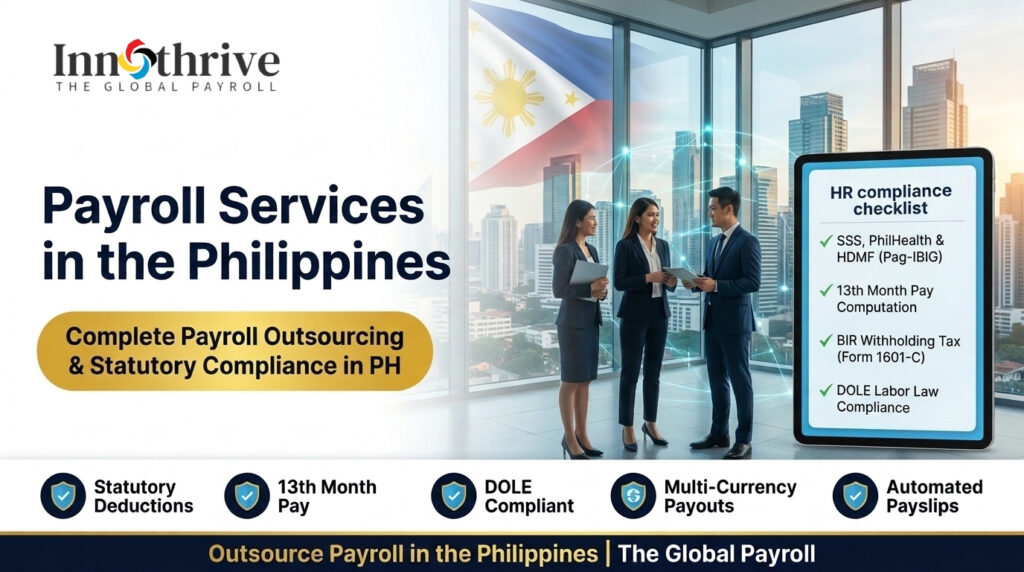
The Philippines has emerged as one of the world’s most attractive destinations for offshore talent, global capability centers (GCCs), and remote customer support and engineering teams. However, running payroll in the Philippines requires navigating a distinct, highly regulated framework overseen by multiple government agencies—including the Bureau of Internal Revenue (BIR), Social Security System (SSS), Philippine Health Insurance Corporation (PhilHealth), and the Home Development Mutual Fund (Pag-IBIG).
Whether you are hiring Filipino remote professionals as an overseas enterprise or establishing a dedicated hub in Manila, Cebu, or Davao, understanding local statutory contributions, mandatory 13th-month pay, and withholding tax formulas is critical to maintaining 100% compliance and avoiding severe labor penalties.
Key Takeaway for Global Employers:
Foreign companies cannot directly register with Philippine statutory agencies without a registered local entity or an authorized Employer of Record (EOR) / Payroll Outsourcing partner. Partnering with a specialized provider allows you to onboard talent compliantly in 48 hours without establishing a local corporation.
1. Core Components of Philippine Payroll
A standard Philippine employee payslip consists of gross earnings minus statutory deductions and withholding taxes. The standard payroll cycle in the Philippines is semi-monthly—typically disbursed on the 15th and 30th (or 31st) of each month.
- Basic Salary: Fixed monthly contractual compensation (must meet or exceed regional daily minimum wage thresholds set by the National Wages and Productivity Commission).
- De Minimis Benefits: Non-taxable small-value employee allowances (e.g., rice subsidy, medical cash allowance, uniform allowance, laundry allowance) that reduce taxable income when kept within statutory ceilings.
- Overtime & Night Shift Differential: Work performed beyond 8 hours/day entitles employees to overtime pay (+25% regular day, +30% rest day/holiday). Work performed between 10:00 PM and 6:00 AM requires an additional 10% Night Shift Differential (NSD).
- Mandatory Statutory Contributions: Social Security System (SSS), Philippine Health Insurance Corporation (PhilHealth), and Home Development Mutual Fund (Pag-IBIG).
- Bureau of Internal Revenue (BIR) Withholding Tax: Progressive graduated personal income tax withheld at source under Republic Act No. 10963 (TRAIN Law).
2. Mandatory Statutory Contributions Breakdown (2026 Rates)
Philippine labor law mandates three primary social funds funded jointly by employers and employees:
| Agency / Fund | Employer Share | Employee Share | Total Contribution | Monthly Cap |
|---|---|---|---|---|
| SSS (Social Security System) | 10.0% + EC Fund | 5.0% | 15.0% | Max MSC of ₱35,000 (₱5,250 total) |
| PhilHealth (National Health) | 2.5% | 2.5% | 5.0% | ₱10,000 floor – ₱100,000 ceiling (₱5,000 max) |
| Pag-IBIG (HDMF Housing Fund) | ₱200 (2.0%) | ₱200 (2.0%) | ₱400 | ₱200/month maximum mandatory limit |
| Employees’ Compensation (EC) | ₱10 to ₱30 | ₱0 (Employer only) | ₱10 – ₱30 | Fixed flat rate depending on MSC |
Social Security System (SSS) Details
SSS provides protection against sickness, maternity, disability, retirement, death, and unemployment. The monthly contribution is tied to the employee’s Monthly Salary Credit (MSC), with the upper MSC threshold set at ₱35,000. In addition, employers contribute an Employees’ Compensation (EC) payment of ₱10 or ₱30 per employee depending on salary level.
PhilHealth (Health Insurance)
Under the Universal Health Care Act, PhilHealth contribution is calculated at 5% of basic monthly salary, split equally (2.5% employer / 2.5% employee). The monthly salary ceiling is capped at ₱100,000, meaning the maximum monthly contribution is ₱5,000 (₱2,500 each).
Pag-IBIG (Home Development Mutual Fund)
Pag-IBIG provides accessible housing loans and provident savings. Effective 2024 onwards, the mandatory maximum monthly compensation ceiling was increased to ₱10,000, requiring a mandatory employer contribution of ₱200 and employee contribution of ₱200 (₱400 total monthly). Employees may opt to save higher voluntary amounts (MP2).
3. Demystifying the Mandatory 13th-Month Pay
One of the most frequent points of confusion for foreign employers is the **13th-Month Pay**, enacted under Presidential Decree No. 851. It is not an optional performance bonus—it is a **statutory obligation** for all rank-and-file employees who have worked for at least one month during the calendar year.
The Exact 13th-Month Pay Formula:
13th-Month Pay = Total Basic Salary Earned in Calendar Year ÷ 12
- What is included: Basic pay received for all worked days and paid leaves.
- What is excluded: Overtime pay, night shift differentials, cost-of-living allowances (COLA), unused leave encashments, and discretionary bonuses.
- Strict Payment Deadline: Must be disbursed on or before December 24 of each year. Failure to pay on time incurs severe penalties from the Department of Labor and Employment (DOLE).
- Tax Exemption Threshold: Under current BIR regulations, 13th-month pay and other productivity bonuses up to ₱90,000 are 100% tax-exempt. Any excess above ₱90,000 is combined with gross regular compensation and taxed at applicable progressive brackets.
4. Personal Income Tax (TRAIN Law) Withholding Brackets
Employers act as withholding agents for the Bureau of Internal Revenue (BIR). Under the revised TRAIN Law withholding tables, individual employees earning up to ₱250,000 annually (₱20,833/month) pay **0% income tax**. Above this threshold, progressive rates apply:
| Annual Taxable Income (PHP) | Tax Computation Formula |
|---|---|
| Not over ₱250,000 | 0% (Tax-Exempt) |
| ₱250,001 to ₱400,000 | 15% of the excess over ₱250,000 |
| ₱400,001 to ₱800,000 | ₱22,500 + 20% of the excess over ₱400,000 |
| ₱800,001 to ₱2,000,000 | ₱102,500 + 25% of the excess over ₱800,000 |
| ₱2,000,001 to ₱8,000,000 | ₱402,500 + 30% of the excess over ₱2,000,000 |
| Over ₱8,000,000 | ₱2,202,500 + 35% of the excess over ₱8,000,000 |
At the end of each calendar year, employers must complete **Year-End Tax Annualization** (BIR Form 2316), calculating whether exact taxes were withheld or if refunds / adjustments are owed to employees on their final December payroll.
5. Leave Entitlements & Mandatory Benefits
In addition to statutory funds and 13th-month pay, Philippine labor standards mandate several paid leaves:
- Service Incentive Leave (SIL): Minimum 5 days of paid leave per year for employees with at least 1 year of service. Unused SIL must be converted to cash at the end of the year.
- Maternity Leave (Expanded Maternity Leave Law): 105 days of fully paid leave for female employees regardless of civil status, with an option for 30 additional days of unpaid leave.
- Paternity Leave: 7 days of fully paid leave for married male employees for up to 4 deliveries of their lawful spouse.
- Solo Parent Leave: 7 days of paid leave for qualified single parents under RA 8972.
- Special Leave for Women (Magna Carta of Women): Up to 2 months of fully paid leave following surgery caused by gynecological disorders.
- VAWC Leave: 10 days of fully paid leave for female victims of violence against women and children under RA 9262.
6. How Foreign Companies Can Compliantly Hire in the Philippines
International companies looking to hire talent in the Philippines typically have two operational routes:
Option A: Incorporate a Local Subsidiary (SEC Registration)
Requires registration with the Securities and Exchange Commission (SEC), minimum paid-in capital (often \$200,000 for foreign-owned domestic market enterprises unless export-oriented), local resident directors, Barangay clearances, municipal business permits, and Bureau of Internal Revenue registrations. Timeline: 3 to 6 months with high ongoing administrative costs.
Option B: Partner with an Employer of Record (EOR) / Global Payroll Provider
The fastest and most cost-effective path. An Employer of Record acts as the legal employer of record on paper, managing local employment contracts, monthly SSS/PhilHealth/Pag-IBIG remittances, BIR tax withholdings, 13th-month pay, and local HR compliance, while you maintain full day-to-day operational control over your workforce. Onboarding timeline: 48 to 72 hours with zero entity formation expenses.
Why Choose The Global Payroll for Philippines Payroll Outsourcing?
Managing cross-border payroll across different time zones, tax laws, and currencies can drain internal HR resources. The Global Payroll (TGP) provides dedicated end-to-end payroll outsourcing and EOR services tailored for global enterprises:
- 100% Guaranteed Statutory Compliance: Timely electronic filing and remittance to SSS, PhilHealth, Pag-IBIG, and BIR.
- Flawless 13th-Month & Tax Annualization: Automated tracking of pro-rata calculations and year-end Form 2316 issuance.
- Multi-Country Unified Dashboard: Consolidate your Philippine payroll alongside your teams in Singapore, Indonesia, USA, and India under one consolidated invoice.
- Direct Currency Disbursement: Fast, secure direct-deposit payroll payments into local Philippine peso (PHP) bank accounts.
Ready to Streamline Your Philippines Payroll?
Speak with our international payroll specialists today to discuss how we can onboard and manage your Philippine workforce compliantly and efficiently.
Frequently Asked Questions (FAQs)
1. Is 13th-month pay mandatory for remote Filipino workers?
Yes. Under Presidential Decree No. 851, all rank-and-file employees who have worked for at least one month are legally entitled to 13th-month pay, calculated as one-twelfth of their total basic salary earned during the calendar year, payable on or before December 24.
2. Can a US or European company hire employees in the Philippines without establishing a local company?
Yes. By engaging an Employer of Record (EOR) like The Global Payroll, foreign businesses can compliantly employ workers in the Philippines without registering a local entity. The EOR handles all local employment contracts, statutory contributions, and payroll taxes.
3. What is the standard payroll frequency in the Philippines?
The standard payroll cycle in the Philippines is semi-monthly (twice a month), typically paid on the 15th and 30th (or 31st) of each month, or every other Friday.
4. Are allowances and bonuses subject to income tax in the Philippines?
De minimis allowances within statutory limits are exempt from withholding tax and social security contributions. Additionally, 13th-month pay and other bonuses up to ₱90,000 per calendar year are completely tax-exempt under BIR regulations.
5. What are the penalties for late remittance of SSS, PhilHealth, or Pag-IBIG?
Late remittances incur monthly penalty interest (typically 2% to 3% per month) plus potential criminal and administrative sanctions under the Social Security Act and Universal Health Care Act. Outsourcing payroll ensures guaranteed on-time statutory remittances.