







Hiring top talent in the United States offers overseas enterprises unparalleled access to market expertise, sales leadership, and technical innovation. However, one of the most perilous legal minefields global employers encounter is worker classification: 1099 Independent Contractor vs. W-2 Full-Time Employee.
With aggressive joint enforcement by the Internal Revenue Service (IRS), the Department of Labor (DOL), and state regulatory agencies, treating a worker as a 1099 independent contractor when they function as an employee can lead to devastating retroactive payroll tax liabilities, massive statutory interest, and severe civil penalties.
Hiring US Talent Without a US Legal Entity:
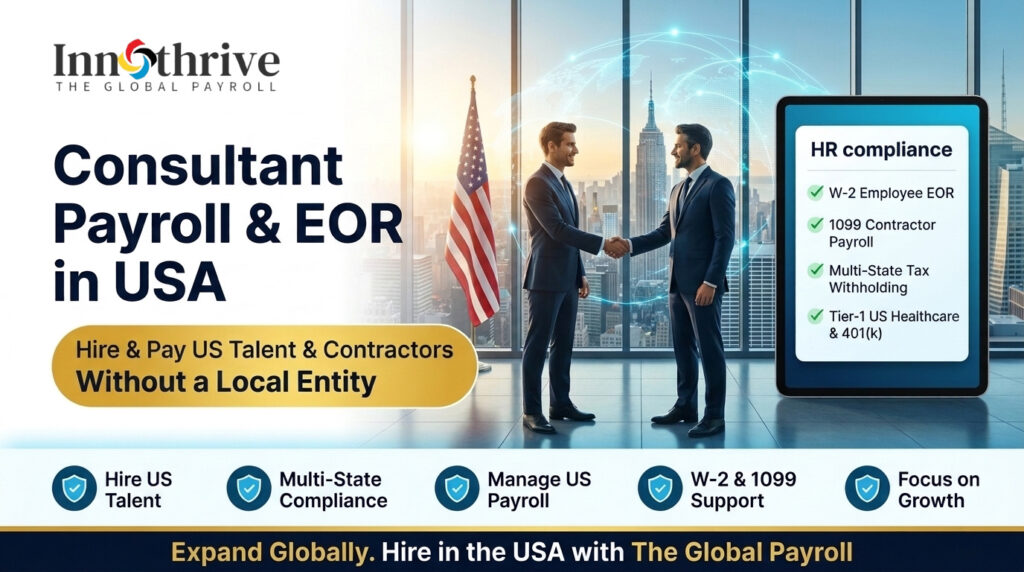
Foreign companies cannot directly sponsor W-2 employees without a registered US entity (such as a Delaware C-Corp) or an Employer of Record. Partnering with an authorized USA Employer of Record (EOR) & Consultant Payroll provider enables you to legally onboard US talent in all 50 states within 48 hours.
1. Quick Comparison: 1099 Contractor vs. W-2 Employee
The classification defines not only tax withholdings, but also behavioral control, benefit obligations, and intellectual property ownership:
| Dimension | 1099 Independent Contractor | W-2 Employed Worker |
|---|---|---|
| Legal Relationship | Independent business-to-business (B2B) vendor | Direct employer-employee relationship |
| Behavioral Control | Controls how, when, and where the work is done | Employer dictates working hours, tools, processes |
| Tax Withholding | No withholding; contractor pays 15.3% Self-Employment (SECA) tax | Employer withholds federal/state income tax & FICA (7.65% match) |
| Statutory Benefits | Ineligible for benefits, paid time off, or overtime | Entitled to statutory benefits, workers’ comp, unemployment, PTO |
| Exclusivity | May serve multiple clients simultaneously | Typically works exclusively for one primary employer |
| Annual Tax Form | Form 1099-NEC (filed by Jan 31) | Form W-2 (Wage and Tax Statement) |
2. How the DOL & IRS Determine Worker Classification
A signed independent contractor agreement does **not** protect your company from misclassification liability if the underlying facts of the working relationship resemble employment. Regulatory bodies use rigorous legal frameworks to evaluate workers:
A. The US Department of Labor (DOL) Economic Reality Test
Under the Fair Labor Standards Act (FLSA), the DOL analyzes six core factors with no single factor determinative:
- Opportunity for Profit or Loss: Does the worker have managerial skill that affects their earnings, such as negotiating rates or making capital investments?
- Investments by the Worker and Employer: Does the worker purchase significant capital equipment, software, or facilities independently?
- Degree of Permanence: Is the work continuous, indefinite, or full-time (indicative of W-2), or project-based with defined deliverables (indicative of 1099)?
- Nature and Degree of Control: Does the hiring entity set working hours, mandate specific software, supervise daily tasks, or prevent the worker from working for competitors?
- Integrity to the Business: Is the work performed an integral part of the business’s core product or service offering?
- Skill and Initiative: Does the worker apply specialized technical expertise with independent business judgment?
B. State-Level “ABC” Tests (California, New York, New Jersey)
Several states enforce the substantially stricter ABC Test (such as California’s Assembly Bill 5). Under the ABC test, a worker is presumed to be an employee unless the hiring business proves all three prongs:
Prong A: The worker is free from the control and direction of the hiring entity in connection with the performance of the work, both under the contract and in fact.
Prong B: The worker performs work that is outside the usual course of the hiring entity’s business.
Prong C: The worker is customarily engaged in an independently established trade, occupation, or business of the same nature as that involved in the work performed.
Example: If an international SaaS company hires a US software engineer to build core platform features, that worker automatically fails Prong B because software development is the core business of the hiring company. That worker MUST be classified as a W-2 employee.
3. The Financial Consequences of Misclassification
If the IRS or state authorities audit your company and reclassify a 1099 contractor as a W-2 employee, the financial penalties are substantial:
- Back Federal Withholding Taxes: 1.5% of wages paid (or up to 3% if Form 1099 was not filed) plus 20% of the employee’s share of FICA (Social Security and Medicare).
- Employer FICA Arrears: 100% of the employer’s unpaid FICA contributions (7.65% of all gross payments).
- Federal Unemployment Tax (FUTA): Retroactive payments plus interest.
- State Unemployment & Workers’ Comp: Unpaid state unemployment insurance (SUI) and mandatory workers’ compensation insurance premiums plus statutory surcharges.
- Overtime & Wage Claims: Retroactive overtime pay under the FLSA, plus potential double liquidated damages and plaintiff attorney fee awards.
- Willful Misclassification Penalties: If determined willful, penalties can reach up to \$25,000 per violation under state laws, alongside personal liability for company directors.
4. How an Employer of Record (EOR) Solves the Dilemma
For international companies looking to hire key personnel in the United States without establishing an expensive US subsidiary, an Employer of Record (EOR) eliminates 100% of misclassification risks:
The EOR Advantage in the USA:
- W-2 Employment Without a US Entity: The EOR serves as the legal employer of record on paper, registered across all 50 US states.
- Full Multi-State Tax Compliance: Automated withholding and remittance for Federal Income Tax, FICA, State Income Tax (SIT), State Unemployment Insurance (SUI), and local city payroll taxes.
- Statutory & Supplemental Benefits: Provides enterprise-grade healthcare (ACA-compliant medical, dental, vision), 401(k) retirement plans, and workers’ compensation coverage.
- Watertight Intellectual Property Protection: Direct assignment of inventions and confidentiality agreements safeguarding proprietary IP under US law.
Transitioning Contractors to W-2 Employees
Many global tech firms test new US markets by engaging independent consultants on a 1099 basis during initial scoping. As project commitments grow into full-time operational roles, transitioning those workers into W-2 employment becomes essential.
The Global Payroll provides a hybrid model, enabling companies to manage both compliant 1099 consultant payments and seamless W-2 EOR conversions on one unified global payroll platform.
Hire US Talent Compliantly Today
Protect your business from misclassification liabilities. Speak with our US payroll and EOR specialists to onboard talent across any US state with full compliance.
Frequently Asked Questions (FAQs)
1. Can a foreign company hire a US worker as an independent contractor without paying US taxes?
Yes, provided the worker qualifies legitimately as an independent contractor under the DOL economic reality test and state ABC tests. In this case, the foreign company collects a Form W-9 and issues Form 1099-NEC without withholding taxes. However, if the worker functions as a full-time employee, misclassification penalties will apply.
2. What is the difference between Form 1099 and Form W-2?
Form 1099-NEC reports non-employee compensation paid to independent contractors with zero payroll tax withholdings. Form W-2 reports wages and statutory withholdings (federal/state income tax, Social Security, Medicare) paid to direct employees.
3. Can an overseas company hire W-2 employees in the US without opening a US corporation?
Yes. By using an Employer of Record (EOR) like The Global Payroll, foreign enterprises can employ W-2 staff across all 50 US states compliantly without establishing a domestic US legal entity.
4. What triggers an IRS or state worker misclassification audit?
Common audit triggers include a 1099 contractor filing for unemployment benefits or workers’ compensation, submitting IRS Form SS-8 (Determination of Worker Status), or cross-agency data sharing between state labor departments and the IRS.
5. How quickly can an EOR transition a US contractor to a W-2 employee?
With The Global Payroll, the transition can be executed seamlessly in 48 to 72 hours, including state tax registrations, compliant W-2 employment agreements, ACA-compliant benefits enrollment, and direct deposit payroll setup.