








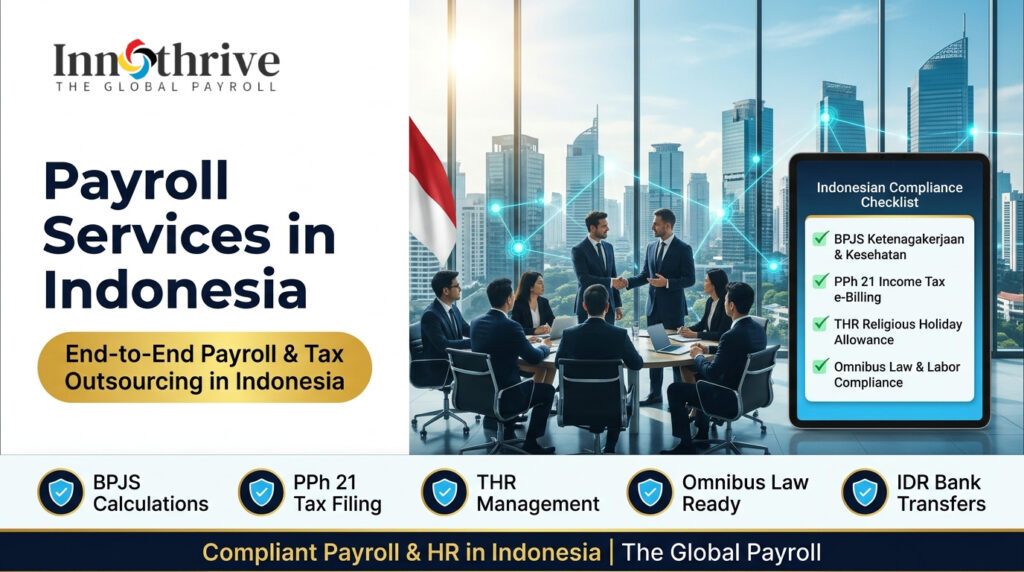
With the largest digital economy in Southeast Asia and a rapidly growing population of over 280 million, Indonesia has become a primary target for multinational expansion, technology hiring, and offshore operations. However, navigating payroll in Indonesia requires managing a multi-tiered regulatory framework governed by the Ministry of Manpower (Kemnaker), the Directorate General of Taxes (DJP), and the dual social security bodies—BPJS Ketenagakerjaan and BPJS Kesehatan.
From calculating mandatory religious holiday allowances (**THR**) to managing dynamic provincial minimum wages (UMP/UMK) and applying the revised **PPh 21 Effective Average Tax Rate (TER)** scheme, overseas employers must ensure airtight payroll operations to avoid harsh administrative and financial penalties.
Hiring in Indonesia Without a Local Legal Entity (PT PMA):
Foreign enterprises do not need to undergo the complex, capital-intensive process of incorporating a foreign-owned limited liability company (PT PMA) with strict minimum capital requirements (typically IDR 10 billion). By partnering with an authorized Indonesia Payroll Outsourcing & Employer of Record (EOR) provider, you can compliantly onboard local Indonesian talent in 48 to 72 hours.
1. Core Components of Indonesian Payroll
Under Indonesian labor law (specifically Law No. 13/2003 as amended by the **Job Creation Law / Omnibus Law** and Government Regulation PP No. 36/2021), employee compensation is typically paid on a monthly frequency (usually on the 25th or last business day of the month). A standard salary package consists of:
- Basic Salary (Gaji Pokok): The fundamental remuneration agreed upon. Indonesian labor law mandates that basic salary must represent at least 75% of total fixed monthly remuneration (basic salary + fixed allowances).
- Fixed Allowances (Tunjangan Tetap): Consistent monthly payments that do not vary based on attendance or performance (e.g., position or role allowances).
- Non-Fixed Allowances (Tunjangan Tidak Tetap): Variable compensation linked directly to attendance, meals, transport, or project milestones.
- Statutory Social Security Contributions (BPJS): Mandatory employer and employee withholdings split between employment and health programs.
- Withholding Income Tax (PPh 21 / PPh 26): Progressive personal income tax deducted by the employer and remitted directly to the Directorate General of Taxes (DJP).
2. Mandatory Social Security (BPJS) Breakdown
Social security in Indonesia is administered by two distinct public institutions: **BPJS Ketenagakerjaan** (Workers’ Social Security) and **BPJS Kesehatan** (Healthcare Social Security). Participation is legally compulsory for all local employees and foreign nationals working in Indonesia for at least 6 months.
| Program / Agency | Employer Share | Employee Share | Total Contribution | Monthly Salary Cap |
|---|---|---|---|---|
| BPJS Kesehatan (Healthcare) | 4.0% | 1.0% | 5.0% | Capped at IDR 12,000,000 / month |
| JKK (Work Accident Protection) | 0.24% – 1.74% | 0% | 0.24% – 1.74% | No cap (tiered by industry risk) |
| JKM (Life / Death Security) | 0.30% | 0% | 0.30% | No salary ceiling |
| JHT (Old-Age Savings / Provident) | 3.70% | 2.00% | 5.70% | No salary ceiling |
| JP (Pension Security) | 2.00% | 1.00% | 3.00% | Capped at IDR 10,042,300 / month |
| JKP (Job Loss Protection) | Funded by Govt & JKK/JKM | 0% | Included | Provides cash allowance upon layoff |
Summary of Total Mandatory Contributions:
- Total Employer Burden: Approximately 10.24% to 11.74% of monthly salary (depending on industry workplace risk category).
- Total Employee Burden: Exactly 4.00% of monthly salary withheld at source.
- Payment Deadline: Remittance for both BPJS Kesehatan and BPJS Ketenagakerjaan must be paid by the 10th and 15th of each following month, respectively.
3. Mandatory Religious Holiday Allowance (THR Keagamaan)
In Indonesia, the **Tunjangan Hari Raya (THR)** is not a discretionary bonus—it is a strict **statutory entitlement** governed by Regulation of the Minister of Manpower No. 6/2016. Every employer is legally required to pay THR to all employees who have worked for at least one continuous month.
How THR is Calculated & When it Must be Paid:
- Employees with 12+ Months of Service: Entitled to exactly 1 full month’s basic salary plus fixed allowances.
- Employees with 1 to 11 Months of Service: Paid on a pro-rata basis:
(Months of Service ÷ 12) × 1 Month's Salary. - Religious Timing: Paid according to the employee’s declared religion (e.g., Eid al-Fitr for Muslims, Christmas for Christians/Catholics, Nyepi for Hindus, Waisak for Buddhists). In practice, most multinational corporations pay all staff simultaneously prior to Eid al-Fitr (Lebaran) by mutual agreement.
- Payment Deadline: Must be paid in full no later than 7 days prior to the religious holiday. Late payments incur a statutory penalty of 5% of the total THR amount, which does not relieve the employer from the obligation to pay the full THR itself.
- Cash Payment Only: THR must be disbursed strictly in cash/bank transfer—it cannot be substituted with merchandise, gift cards, or company hampers.
4. Personal Income Tax (PPh 21) & The New TER Withholding Scheme
Income tax on employment income in Indonesia is known as **PPh 21** (Pajak Penghasilan Pasal 21). Employers are legally designated as withholding agents responsible for calculating, deducting, and remitting PPh 21 to the state treasury by the 10th of the following month, with electronic tax returns (SPT Masa PPh 21) filed by the 20th.
The New TER (Effective Average Tax Rate) System
Under Government Regulation PP No. 58/2023 and PMK No. 168/2023, Indonesia completely revamped monthly payroll tax withholding by implementing the **TER (Tarif Efektif Rata-Rata)** system. Instead of complex annualized projections each month, employers now use simplified monthly lookup tables for January through November:
- Monthly Withholding (Jan – Nov):
Monthly PPh 21 Withheld = Gross Monthly Income × Monthly TER Rate (%). - Three TER Categories (A, B, C): Based on the employee’s marital status and number of dependents (PTKP – Non-Taxable Income threshold):
- Category A: Single with 0 dependents (TK/0), Single with 1 dependent (TK/1), or Married with 0 dependents (K/0). Rates range from 0% (up to IDR 5.4M) to 34% (above IDR 1.4B).
- Category B: TK/2, TK/3, K/1, K/2.
- Category C: K/3 (Married with 3 dependents).
- December Tax True-Up: In December (or upon contract termination), the employer calculates the full-year progressive tax under Article 17 of the Income Tax Law, deducts the cumulative PPh 21 already withheld from Jan–Nov, and withholds (or refunds) the exact variance.
| Annual Taxable Income (IDR) | Progressive Tax Rate (Article 17) |
|---|---|
| Up to IDR 60,000,000 | 5% |
| IDR 60,000,001 to IDR 250,000,000 | 15% |
| IDR 250,000,001 to IDR 500,000,000 | 25% |
| IDR 500,000,001 to IDR 5,000,000,000 | 30% |
| Above IDR 5,000,000,000 | 35% |
Note: Indonesian taxpayers must hold an active Tax Identification Number (NPWP), which has now been integrated with the 16-digit National Identity Card number (NIK). Individuals without a registered tax ID are subject to a 20% higher withholding tax rate.
5. Working Hours, Overtime & The Omnibus Law
Under the Omnibus Law (PP No. 35/2021), standard statutory working hours in Indonesia are either:
- 7 hours per day and 40 hours per week (for a 6-day work week); or
- 8 hours per day and 40 hours per week (for a 5-day work week).
Maximum statutory overtime is capped at **4 hours per day and 18 hours per week** (excluding rest days and public holidays). Overtime pay must be computed as follows:
- First hour on regular workdays: 1.5 × hourly wage rate.
- Subsequent hours on regular workdays: 2.0 × hourly wage rate.
- Rest Days & Public Holidays: 2.0 × hourly wage rate for the first 7–8 hours, increasing to 3.0 × and 4.0 × for extended hours.
- Hourly Wage Formula:
1/173 × Monthly Salary (Basic Salary + Fixed Allowances).
6. PKWT (Fixed-Term) vs. PKWTT (Permanent) Contracts & Compensation
Indonesian labor law distinguishes strictly between fixed-term contracts (**PKWT**) and permanent employment (**PKWTT**):
Mandatory PKWT Compensation Pay (Uang Kompensasi)
A critical requirement introduced by the Omnibus Law is that employers must pay **mandatory compensation money** to fixed-term (PKWT) workers upon the completion or extension of their contract (provided they have completed at least 1 continuous month).
The compensation formula mirrors severance: (Months of Service ÷ 12) × 1 Month's Salary. Foreign employers often overlook this liability when budgeting for contract workers in Indonesia.
Why Choose The Global Payroll for Indonesia Payroll Outsourcing?
Managing local Indonesian statutory filings from abroad involves linguistic barriers, localized banking rails, and frequent regulatory shifts. The Global Payroll (TGP) provides a fully integrated, zero-stress payroll and EOR infrastructure for global companies:
- Airtight BPJS Compliance: Direct electronic monthly filings and reconciliations with both BPJS Ketenagakerjaan (SIPP Online) and BPJS Kesehatan (Edabu).
- Seamless PPh 21 TER Automation: Accurate application of Government Regulation No. 58/2023, automated December tax true-ups, and annual Form 1721-A1 issuance.
- Guaranteed On-Time THR Management: Automated pro-rata THR tracking ensuring 100% compliance with Ministry of Manpower payment deadlines.
- Multi-Country Payroll Consolidation: Manage your Indonesian workforce alongside teams in Philippines, Singapore, South Africa, USA, and India with single-currency invoicing and dedicated account management.
Ready to Streamline Your Indonesia Payroll?
Speak with our Southeast Asian payroll and EOR specialists to onboard talent and run compliant payroll across Jakarta, Bali, and nationwide.
Frequently Asked Questions (FAQs)
1. Is THR (Religious Holiday Allowance) mandatory for remote or foreign-managed staff in Indonesia?
Yes. THR is a non-negotiable statutory obligation under Indonesian labor law. Any employee who has worked continuously for at least 1 month is entitled to THR, calculated as 1 month’s salary for staff with 12+ months of service, or pro-rated for those with 1–11 months.
2. Can foreign enterprises employ Indonesian staff without incorporating a PT PMA?
Yes. Through an Employer of Record (EOR) like The Global Payroll, international businesses can legally employ local personnel in Indonesia without establishing a PT PMA. The EOR manages employment agreements, BPJS, PPh 21 taxes, and payroll administration.
3. What is the difference between BPJS Ketenagakerjaan and BPJS Kesehatan?
BPJS Kesehatan administers national healthcare insurance (5% contribution split 4% employer / 1% employee). BPJS Ketenagakerjaan covers employment-related protections, including work accident insurance (JKK), death security (JKM), old-age provident savings (JHT), and pension security (JP).
4. What happens if an employer misses the monthly BPJS or tax payment deadline?
Late payments to BPJS incur monthly late interest penalties (typically 2% per month). Late tax remittances and filings to the tax authority incur administrative fines plus statutory interest charges under the General Tax Provisions and Procedures (KUP) Law.
5. How are fixed-term contract (PKWT) workers compensated upon completion?
Under PP No. 35/2021 of the Omnibus Law, employers must provide compensation pay (Uang Kompensasi) to PKWT employees upon the expiration or extension of their contract, equal to (Months of Service ÷ 12) × 1 Month's Salary.