







For US businesses, accurate bookkeeping is essential for maintaining financial visibility, managing cash flow, preparing tax returns, and making informed business decisions. However, maintaining a full-time in-house bookkeeping team can become expensive and difficult to scale.
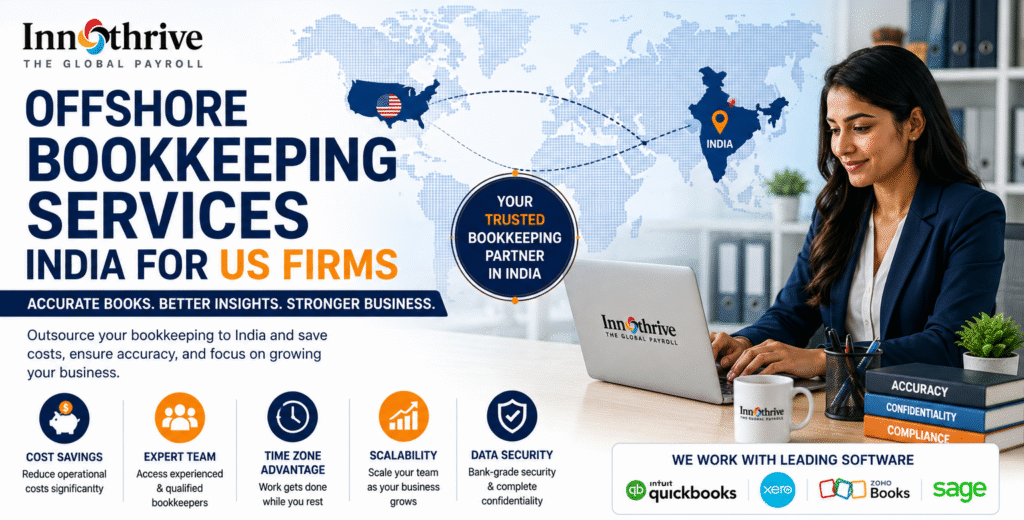
This is why an increasing number of US businesses are exploring offshore bookkeeping services India for US firms.
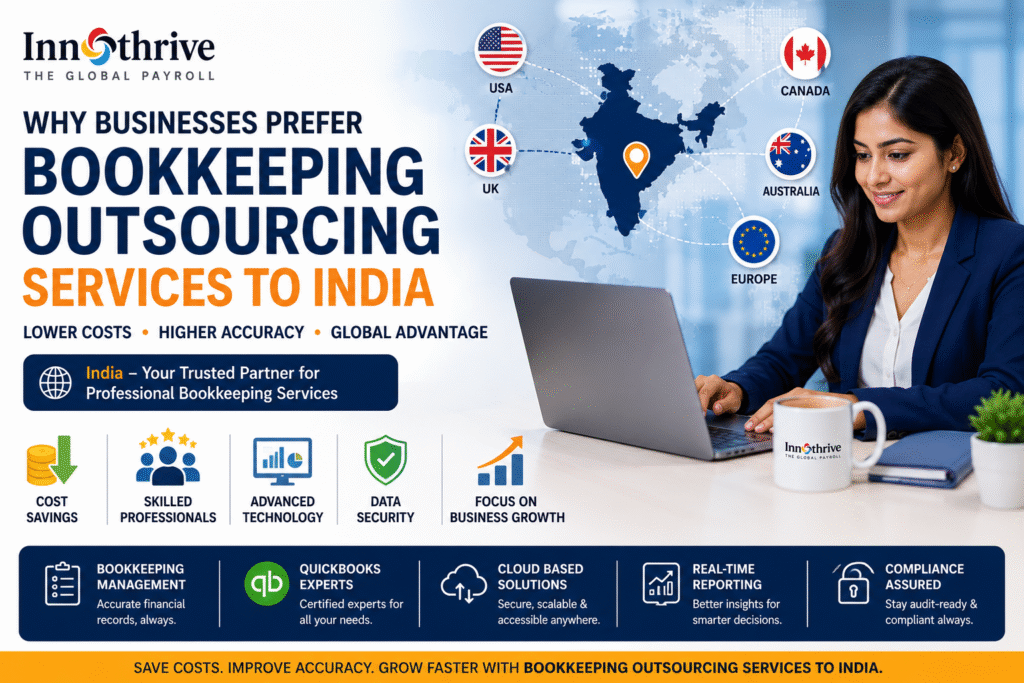
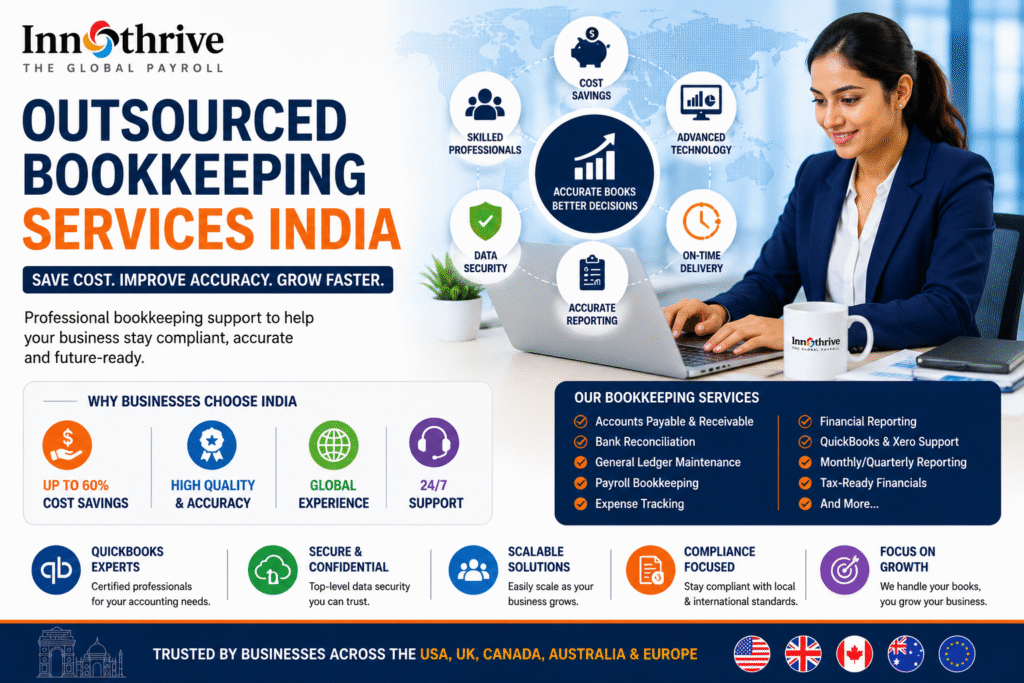
India has developed into a major global destination for accounting and bookkeeping outsourcing, offering access to experienced accounting professionals, modern cloud-based technology, flexible staffing models, and significant cost advantages.
From startups and small businesses to CPA firms and growing enterprises, US organizations can outsource routine and complex bookkeeping activities to India while keeping their focus on business growth.
What Are Offshore Bookkeeping Services?
Offshore bookkeeping involves outsourcing bookkeeping and financial record-management activities to a professional service provider located outside the company’s home country.
For US businesses, an Indian bookkeeping provider can manage activities such as:
- Daily transaction recording
- Bank reconciliation
- Credit card reconciliation
- Accounts payable
- Accounts receivable
- General ledger maintenance
- Expense categorization
- Invoicing
- Payroll bookkeeping
- Month-end closing
- Financial reporting
- QuickBooks bookkeeping
- Tax-ready financial records
The US company retains control over its financial information while the offshore team manages agreed bookkeeping responsibilities.
Why US Firms Outsource Bookkeeping to India
There are several reasons why India has become a preferred destination for US bookkeeping outsourcing.
1. Significant Cost Savings
Maintaining an in-house bookkeeping team involves more than employee salaries.
US businesses may also need to pay for:
- Employee benefits
- Recruitment
- Training
- Office infrastructure
- Accounting software
- Payroll taxes
- Paid leave
- Employee management
Outsourcing allows businesses to access trained professionals without bearing the entire cost of maintaining an internal department.
Depending on the scope of work and staffing model, outsourcing can provide substantial savings compared with hiring equivalent full-time resources in the US.
2. Access to Skilled Bookkeeping Professionals
India has a large pool of accounting and finance professionals.
Offshore bookkeeping teams may include professionals experienced in:
- US accounting
- US GAAP
- QuickBooks
- Xero
- Sage
- Accounts payable
- Accounts receivable
- Financial reporting
- Tax preparation support
This allows US businesses to access specialized skills without going through lengthy local recruitment processes.
3. Strong QuickBooks Expertise
QuickBooks is widely used by US small and mid-sized businesses.
Indian bookkeeping providers commonly support:
- QuickBooks Online
- QuickBooks Desktop
- QuickBooks cleanup
- QuickBooks migration
- Chart of accounts setup
- Bank reconciliation
- Monthly bookkeeping
- Financial reporting
For companies already using QuickBooks, outsourcing bookkeeping can be integrated into their existing accounting workflow.
4. Time Zone Advantage
The time difference between India and the United States can become an operational advantage.
Depending on the location and working arrangement, an Indian bookkeeping team can complete assigned work outside the US business’s regular working hours.
This can help businesses achieve:
- Faster turnaround
- Overnight processing
- Updated financial records
- Quicker month-end closing
- Extended accounting support
Instead of waiting for the next business day to complete routine bookkeeping tasks, businesses can maintain a more continuous workflow.
5. Scalability
Bookkeeping requirements change as a business grows.
A startup may initially need only a few hours of bookkeeping support each week. As the company expands, its requirements may include:
- Daily bookkeeping
- Multiple bank accounts
- Accounts payable management
- Accounts receivable
- Payroll accounting
- Monthly financial reporting
- Management reporting
An offshore provider can increase or decrease resources according to business requirements.
Bookkeeping Services Indian Firms Provide to US Businesses
Bank Reconciliation
Bank reconciliation ensures that accounting records match bank statements and helps identify:
- Missing transactions
- Duplicate entries
- Incorrect postings
- Unrecorded fees
- Timing differences
Regular reconciliation improves financial accuracy.
Accounts Payable Management
Offshore teams can assist with:
- Vendor invoice processing
- Invoice verification
- Payment tracking
- Vendor reconciliation
- AP reporting
This helps businesses maintain organized vendor records.
Accounts Receivable
AR bookkeeping services may include:
- Customer invoicing
- Payment recording
- Outstanding invoice tracking
- Customer account reconciliation
- Aging reports
Accurate AR records help businesses monitor cash flow.
General Ledger Maintenance
The general ledger is the foundation of a company’s financial reporting.
Bookkeeping teams can maintain:
- Revenue accounts
- Expense accounts
- Asset accounts
- Liability accounts
- Equity accounts
Month-End Bookkeeping
Month-end processes can include:
- Account reconciliation
- Accrual entries
- Expense reviews
- Journal entries
- Financial statement preparation
A structured month-end process helps US businesses close their books efficiently.
Offshore Bookkeeping for US CPA Firms
Offshore bookkeeping services are not limited to individual businesses.
US CPA and accounting firms also outsource bookkeeping work to India.
This can help CPA firms:
- Increase capacity
- Reduce routine workload
- Handle more clients
- Improve turnaround time
- Focus on tax and advisory services
- Scale without immediately hiring additional US staff
For accounting firms, an offshore team can function as an extension of the existing practice.
Industries That Use Offshore Bookkeeping Services
Many US industries benefit from bookkeeping outsourcing, including:
Technology & SaaS
Technology companies often require scalable bookkeeping as their transaction volumes increase.
E-Commerce
E-commerce businesses require accurate tracking of:
- Sales
- Refunds
- Payment gateways
- Inventory-related transactions
- Platform fees
Real Estate
Property businesses may require:
- Rental income tracking
- Property expenses
- Vendor payments
- Property-level reporting
Healthcare
Healthcare businesses need accurate financial records while managing complex operational expenses.
Professional Services
Consulting firms, law firms, marketing agencies, and other professional service businesses frequently outsource bookkeeping to reduce administrative workload.
Construction
Construction businesses can benefit from organized project expenses, vendor records, and financial reporting.
How Offshore Bookkeeping Works
A typical offshore bookkeeping engagement follows a structured process.
Step 1: Initial Assessment
The bookkeeping provider reviews:
- Current accounting system
- Transaction volume
- Number of accounts
- Existing bookkeeping processes
- Reporting requirements
Step 2: Data & System Access
The business provides controlled access to required accounting platforms and documents.
Step 3: Chart of Accounts Review
The bookkeeping team reviews the existing chart of accounts and identifies inconsistencies.
Step 4: Bookkeeping Begins
The team handles the agreed tasks according to predefined processes.
Step 5: Reconciliation & Quality Review
Transactions and accounts are reviewed to identify discrepancies.
Step 6: Financial Reporting
Reports are prepared according to the agreed reporting schedule.
Step 7: Regular Review
The US business and offshore team review performance, issues, and upcoming requirements.
Is Offshore Bookkeeping Secure?
Security is one of the most important considerations when outsourcing financial functions.
A reputable provider should have appropriate controls covering:
- Data encryption
- Secure cloud infrastructure
- Role-based access
- Multi-factor authentication
- Confidentiality agreements
- Controlled system permissions
- Secure document sharing
- Regular backups
US businesses should carefully evaluate the provider’s security policies before sharing financial information.
How Much Do Offshore Bookkeeping Services in India Cost?
The cost varies depending on several factors, including:
- Number of transactions
- Number of employees
- Number of accounts
- Accounting software
- Complexity of bookkeeping
- Reporting requirements
- Frequency of service
- Dedicated vs shared resources
A basic monthly bookkeeping engagement will generally cost less than a dedicated accounting team handling AP, AR, payroll accounting, reporting, and tax support.
Therefore, businesses should compare providers based on total value and scope of services, rather than choosing solely on hourly rates.
Offshore Bookkeeping vs In-House Bookkeeping
| Factor | In-House Bookkeeping | Offshore Bookkeeping |
| Hiring Cost | Higher | Lower |
| Employee Benefits | Business responsibility | Included in service model |
| Scalability | Requires hiring | Easier to scale |
| Talent Pool | Local hiring market | Access to global talent |
| Technology | Business-funded | Provider-supported |
| Management | Internal | Provider-managed |
| Time-Zone Coverage | US business hours | Potential extended coverage |
| Cost Structure | Fixed employee cost | Flexible service model |
Best Practices for US Firms Outsourcing Bookkeeping to India
Choose a Provider With US Accounting Experience
Experience with US businesses is important because bookkeeping practices and reporting expectations vary between countries.
Ask whether the provider has experience with:
- US GAAP
- US businesses
- CPA firms
- QuickBooks
- US financial reporting
Define the Scope of Work
Before starting, clearly document:
- Tasks
- Deadlines
- Reporting requirements
- Communication process
- Review procedures
- Escalation process
Use Secure Technology
Avoid sharing financial credentials through unsecured communication channels.
Use controlled access and appropriate security protocols.
Establish Quality Controls
A strong bookkeeping process should include:
- Transaction reviews
- Reconciliation
- Supervisor checks
- Monthly reporting
- Exception reporting
Maintain Clear Communication
Regular communication helps prevent errors and ensures the offshore team understands changes in business operations.
Why Choose Innothrive for Offshore Bookkeeping Services?
Innothrive provides professional offshore bookkeeping services in India for US firms, helping businesses streamline financial operations while controlling accounting costs.
Our services include:
- US bookkeeping
- QuickBooks accounting
- Accounts payable
- Accounts receivable
- Bank reconciliation
- General ledger maintenance
- Payroll accounting
- Financial reporting
- Month-end closing
- Tax-ready bookkeeping
- Offshore accounting support
Our team combines accounting expertise, technology, structured processes, and quality controls to deliver dependable bookkeeping support for growing businesses.
Conclusion
Offshore bookkeeping services India for US firms provide a practical solution for businesses looking to reduce accounting costs, access skilled professionals, improve financial accuracy, and scale their finance operations.
From QuickBooks bookkeeping and bank reconciliation to AP, AR, month-end closing, and financial reporting, Indian outsourcing teams can support a wide range of accounting requirements.
For US businesses, the key is to choose an offshore bookkeeping partner with strong US accounting experience, appropriate security controls, transparent processes, and reliable communication.
With the right partner, outsourcing bookkeeping is not simply a cost-saving strategy—it can become a scalable extension of your finance team.
Frequently Asked Questions
Why do US firms outsource bookkeeping to India?
US firms outsource bookkeeping to India to access skilled accounting professionals, reduce operating costs, improve scalability, and obtain flexible accounting support.
Is offshore bookkeeping suitable for small US businesses?
Yes. Small businesses can outsource selected bookkeeping tasks instead of hiring a full-time bookkeeper, making the model particularly useful when accounting requirements fluctuate.
Can Indian bookkeeping firms work with QuickBooks?
Yes. Many Indian bookkeeping providers have experience with QuickBooks Online and QuickBooks Desktop, along with other accounting platforms.
Can CPA firms outsource bookkeeping to India?
Yes. US CPA and accounting firms frequently use offshore teams to handle routine bookkeeping and accounting processes, allowing their internal professionals to focus on tax, audit, and advisory work.
Is offshore bookkeeping safe for US businesses?
It can be, provided the service provider uses appropriate security controls, access restrictions, confidentiality agreements, secure systems, and established data-handling procedures.
How much can a US company save by outsourcing bookkeeping?
Savings depend on the scope and complexity of the engagement. Businesses should compare the total cost of an outsourced solution with salaries, benefits, recruitment, software, infrastructure, and management costs associated with an in-house team.