






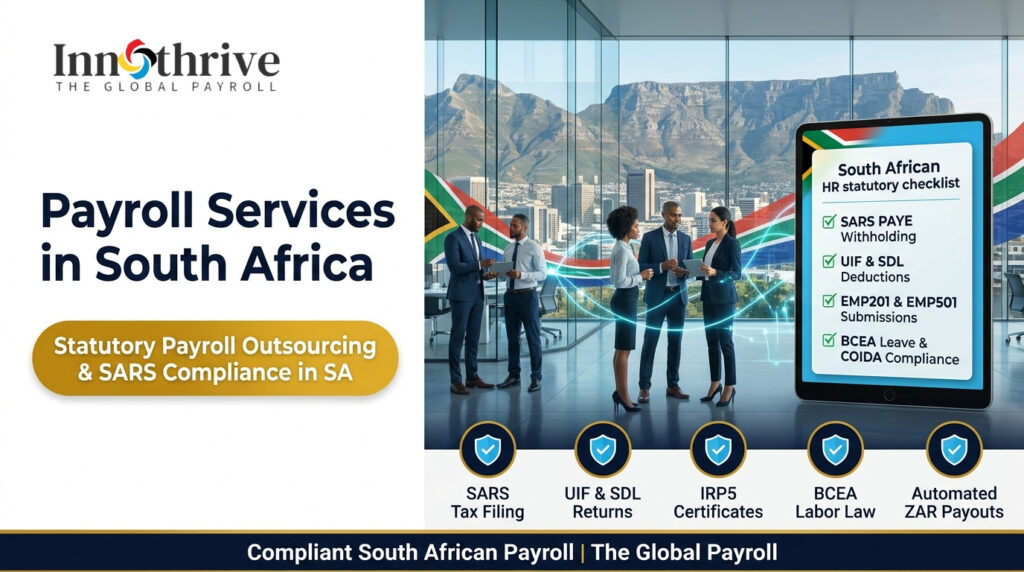
South Africa is widely recognized as the premier economic and financial gateway to Sub-Saharan Africa. With an advanced banking infrastructure, an English-fluent talent pool, and time zones favorable for European, UK, and US operations, global enterprises increasingly recruit South African professionals for software engineering, financial services, customer operations, and management roles.
However, running payroll in South Africa involves adhering to a rigorous statutory landscape overseen by the South African Revenue Service (SARS) and the Department of Employment and Labour (DEL). Employers must manage monthly Pay-As-You-Earn (PAYE) withholdings, Unemployment Insurance Fund (UIF) caps, Skills Development Levies (SDL), and strict working regulations under the Basic Conditions of Employment Act (BCEA).
Hiring in South Africa Without Incorporating a Local Entity:
Foreign corporations can hire and onboard South African talent compliantly without establishing a domestic private company (Pty Ltd) or registering with SARS as an external company. By partnering with an authorized South Africa Payroll Outsourcing & Employer of Record (EOR) provider, you can employ local professionals in just 48 to 72 hours with 100% statutory indemnification.
1. Fundamentals of South African Payroll Operations
Payroll in South Africa is traditionally processed on a monthly frequency, typically distributed between the 25th and the last business day of the calendar month (weekly and fortnightly payrolls are common for wage/hourly workers). Key components of a compliant remuneration package include:
- Basic Salary: Fixed monthly contractual remuneration (must meet or exceed the National Minimum Wage threshold, reviewed annually by the Minister of Employment and Labour).
- Cost-to-Company (CTC) Structuring: Most professional salaries in South Africa are quoted on a Total Cost-to-Company (CTC) basis, encompassing basic salary, retirement fund contributions, medical aid subsidies, and travel allowances.
- Itemized Payslip Requirement: Under Section 33 of the BCEA, employers must provide a written or electronic payslip detailing gross wages, calculations, period, exact statutory deductions, and net earnings on or before payday.
- Statutory Deductions & Taxes: PAYE (income tax), UIF (unemployment insurance), SDL (skills development levy), and COIDA (workplace injury insurance).
2. SARS Personal Income Tax (PAYE) Framework
Under the Income Tax Act No. 58 of 1962, employers are legally obligated to operate as withholding agents for the South African Revenue Service (SARS) through the **Pay-As-You-Earn (PAYE)** system. Taxes are withheld monthly based on progressive marginal brackets ranging from 18% to 45%:
| Taxable Income Bracket (ZAR) | Rates of Tax (PAYE) |
|---|---|
| 1 to 237,100 | 18% of taxable income |
| 237,101 to 370,500 | R42,678 + 26% of taxable income above R237,100 |
| 370,501 to 512,800 | R77,362 + 31% of taxable income above R370,500 |
| 512,801 to 673,000 | R121,475 + 36% of taxable income above R512,800 |
| 673,001 to 857,900 | R179,147 + 39% of taxable income above R673,000 |
| 857,901 to 1,817,000 | R251,258 + 41% of taxable income above R857,900 |
| 1,817,001 and above | R644,489 + 45% of taxable income above R1,817,000 |
Tax Rebates & Medical Scheme Credits
SARS provides statutory tax relief mechanisms that payroll administrators must compute:
- Primary Tax Rebate: An annual statutory rebate (R17,235) deducted directly from the calculated tax liability for all individual taxpayers, setting the basic tax threshold.
- Secondary / Tertiary Rebates: Additional rebates applicable to employees aged 65 to 74 (R9,444) and 75 and older (R3,145).
- Medical Scheme Fees Tax Credit (MTC): A fixed monthly tax credit per member (R364 for main member, R364 for first dependent, R246 for each additional dependent) deducted from monthly PAYE.
3. Mandatory Statutory Funds: UIF, SDL & COIDA
Beyond income tax, three critical social funds require monthly and annual contributions:
| Statutory Fund | Employer Share | Employee Share | Total Contribution | Monthly Ceiling / Threshold |
|---|---|---|---|---|
| UIF (Unemployment Insurance) | 1.0% | 1.0% | 2.0% | Capped at R17,712/mo (Max R177.12 each) |
| SDL (Skills Development Levy) | 1.0% | 0% | 1.0% | Exempt if total payroll < R500,000/year |
| COIDA (Workplace Injury Fund) | 0.11% – 8.26% | 0% | Industry specific | Annual assessment (capped per employee) |
1. Unemployment Insurance Fund (UIF)
UIF provides short-term financial relief to workers who become unemployed or are unable to work due to illness, maternity, or adoption leave. Contributions are equal to 2% of remuneration (1% deducted from employee salary, 1% contributed by employer), capped at a monthly remuneration threshold of **ZAR 17,712** (meaning the maximum deduction is ZAR 177.12 from each party).
2. Skills Development Levy (SDL)
SDL is an employer-paid levy of 1% of total leviable payroll, designed to develop and improve skills across the domestic workforce. Companies with an annual payroll of less than ZAR 500,000 over a 12-month period are legally exempt from SDL.
3. COIDA (Workplace Compensation Fund)
Administered by the Compensation Commissioner under the Department of Employment and Labour, COIDA protects employers against civil liability for occupational injuries. Employers submit an annual Return of Earnings (ROE) by March 31, and an assessment tariff is levied based on industry risk (e.g., tech and clerical office roles incur minimal rates around 0.11%–0.25%).
4. Monthly Reporting & Year-End Reconciliations (EMP201 & EMP501)
SARS maintains a rigorous compliance calendar that requires strict administrative discipline:
The SARS Payroll Filing Lifecycle:
- Monthly EMP201 Submission: Employers must file an electronic EMP201 return and remit all withheld PAYE, UIF, and SDL funds to SARS on or before the 7th day of the following month. Late payments trigger an automatic 10% penalty plus statutory daily interest.
- Bi-Annual Employer Reconciliation (Interim EMP501): Submitted in September/October reconciling all payroll payments and deductions for the first 6 months of the tax year (March 1 to August 31).
- Annual Employer Reconciliation (Final EMP501 & IRP5/IT3(a)): Submitted in May covering the full tax year (March 1 to February 28/29). Employers must issue official IRP5/IT3(a) tax certificates to every employee, detailing gross earnings and taxes paid.
5. Working Hours, Overtime & Leave Standards under the BCEA
The **Basic Conditions of Employment Act (BCEA)** sets non-negotiable minimum employee entitlements across South Africa:
- Maximum Ordinary Hours: 45 hours per week (9 hours per day for a 5-day work week, or 8 hours per day for more than 5 days).
- Overtime Thresholds: Overtime is voluntary and capped at 10 hours per week (maximum 12 total working hours in any single day). Overtime must be paid at a minimum rate of 1.5 times the normal hourly wage, or 2.0 times for Sundays and official public holidays.
- Earnings Threshold Exemption: Employees earning above the BCEA statutory earnings threshold (currently ZAR 254,371.67 per annum) are excluded from mandatory overtime, meal intervals, and Sunday pay regulations, although contractual agreements prevail.
- Annual Leave: Minimum 21 consecutive days (15 working days for a 5-day week) of fully paid leave per annual leave cycle.
- Paid Sick Leave: In a 3-year cycle, employees are entitled to paid sick leave equal to the number of days they would typically work in a 6-week period (30 days for 5-day work weeks).
- Parental Leave: 10 consecutive days of unpaid parental leave for fathers/partners, claimable through the UIF. Female employees receive 4 consecutive months of maternity leave (unpaid by default, supported via UIF claims, though many employers provide paid benefits).
6. 13th-Month Cheques & Discretionary Bonuses
In South Africa, a **13th cheque** (annual bonus) is not a statutory requirement (unlike in the Philippines). However, it is an established commercial custom, particularly in retail, banking, and shared services.
If an employer contractually commits to a 13th cheque or discretionary performance bonus, it forms part of the employee’s remuneration and is fully subject to PAYE tax withholding in the month it is paid. Many corporate employers use annualized bonus tax provisions across the year to prevent a massive single-month tax shock for staff in December.
Why Choose The Global Payroll for South Africa Payroll Outsourcing?
Managing South African payroll from an overseas head office presents unique compliance challenges, strict SARS eFiling authentication protocols, and rigorous exchange control considerations. The Global Payroll (TGP) provides a trusted, enterprise-grade payroll and Employer of Record infrastructure:
- 100% Guaranteed SARS Compliance: Full management of monthly EMP201 submissions, UIF/SDL payments, bi-annual EMP501 reconciliations, and IRP5 issuance via SARS eFiling.
- BCEA-Compliant Documentation: Fully compliant electronic itemized payslips, leave tracking, and employment contracts adhering to South African labor court precedents.
- Direct Currency Disbursement: Rapid, secure payroll distribution directly into South African Rand (ZAR) bank accounts via trusted clearing rails.
- Unified Global Management: Consolidate your South African workforce alongside teams in Philippines, Singapore, Indonesia, USA, and India under one consolidated dashboard and single currency invoice.
Ready to Streamline Your South Africa Payroll?
Speak with our international payroll specialists today to discuss how we can onboard, manage, and scale your South African workforce with zero compliance headaches.
Frequently Asked Questions (FAQs)
1. Can an overseas company employ workers in South Africa without a local company?
Yes. By using an Employer of Record (EOR) like The Global Payroll, foreign enterprises can legally employ South African workers without registering an external company or local Pty Ltd entity. The EOR manages employment agreements, SARS PAYE, UIF, SDL, and HR compliance.
2. What is the monthly filing deadline for South African payroll taxes?
Monthly EMP201 declarations and payments for PAYE, UIF, and SDL must be submitted to SARS on or before the 7th day of the month following the payroll period (or the preceding business day if the 7th falls on a weekend or public holiday).
3. Is an annual 13th-month bonus mandatory in South Africa?
No. Unlike several jurisdictions, a 13th-month bonus is not a statutory requirement in South Africa. It is customary and discretionary unless explicitly written into the employee’s employment contract or collective bargaining agreement.
4. What is the maximum monthly UIF contribution in South Africa?
The Unemployment Insurance Fund (UIF) contribution is capped at a monthly remuneration ceiling of ZAR 17,712. With contributions split at 1% employee and 1% employer, the maximum statutory deduction is capped at ZAR 177.12 per party per month (ZAR 354.24 total).
5. What are IRP5 certificates and when must they be distributed to staff?
An IRP5 is an official annual tax certificate issued to employees detailing their total remuneration, taxable fringe benefits, and all statutory deductions withheld throughout the tax year. Employers must generate and distribute these certificates following the annual EMP501 reconciliation in May.